4. Experimental Implementation
This chapter introduces the apparatus used and the underlying measurement principles. Ultrasound spectroscopy, the principal measurement method, is described first, including the different measurement techniques. Light scattering and densitometry are then considered.
4.1 Principle
The theory of sound propagation described in Chapter 3 determines the technical implementation of the experiments. A measuring cell consists of an ultrasonic transmitter, a measuring volume and a receiver, separated by a defined distance within the liquid. Spectral contributions caused by molecular processes in a substance frequently extend over several decades of the absorption spectrum (Fig. 4.1).
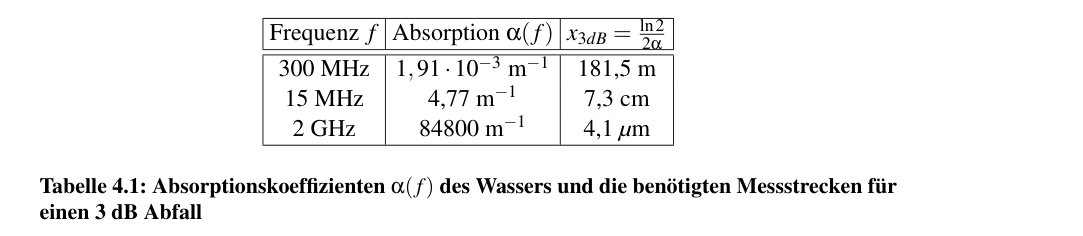
Table 4.1: Absorption coefficients α(f) of water and the propagation distances required for a 3 dB decrease.
Consider the propagation distance required in a real system, such as water, as a function of frequency f to obtain a 3 dB decrease in an ultrasonic wave, as predicted by hydrodynamics (see Chapter 3). It quickly becomes evident that a single experimental setup cannot cover the entire frequency range (Table 4.1). The required propagation distances differ so greatly that only a combination of instruments and ultrasonic measurement methods can achieve this objective.
A useful additional advantage of this approach is the possibility of checking the consistency of measurements obtained with different instruments: the results must join continuously within the overall spectrum (Fig. 4.1). The individual measurement techniques are described in the following sections.
4.2 Resonators: Measurement Range from 15 kHz to 20 MHz
The preceding chapter noted that the required propagation distances depend on frequency. At low frequencies (cf. Table 4.1), determining attenuation by varying the separation would require correspondingly large experimental apparatus.
Original mathematical notation is preserved in the extracted image assets.