4.7 Densitometer
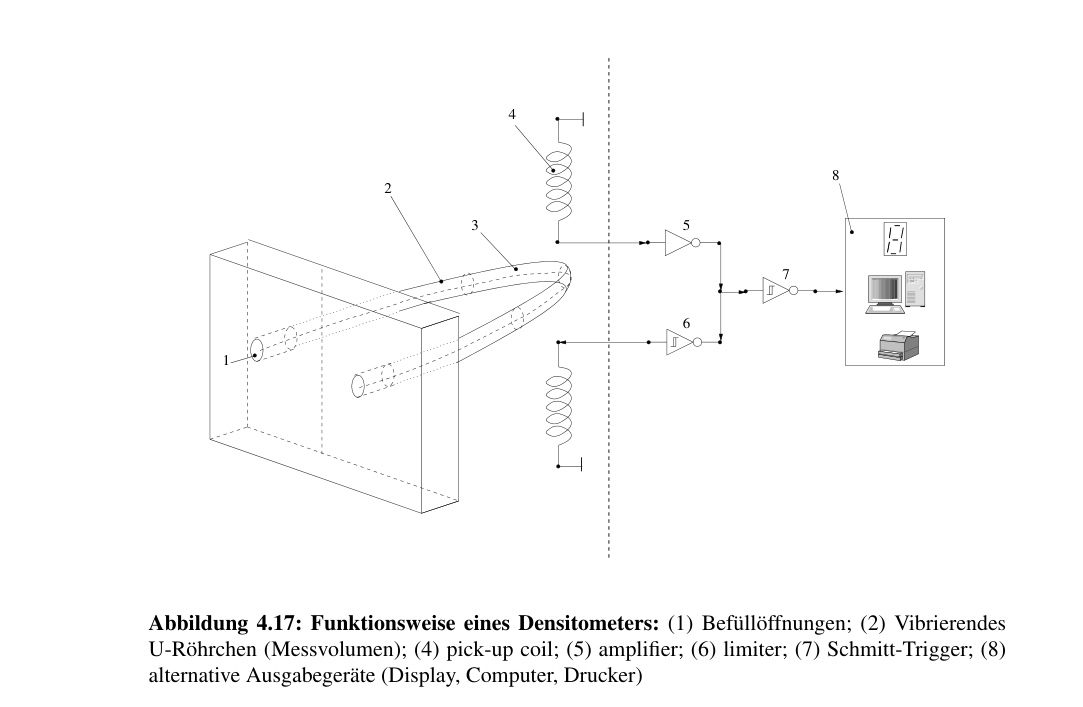
Figure 4.17. Operating principle of a densitometer: (1) filling openings; (2) vibrating U-shaped tube (measurement volume); (4) pickup coil; (5) amplifier; (6) limiter; (7) Schmitt trigger; (8) alternative output devices (display, computer, printer). The numbering follows the original caption.
Density measurements, which are essential for evaluating both the ultrasound and light-scattering data, were carried out using a commercial DMA 5000 instrument manufactured by ANTON PAAR. Although the exact internal measurement sequence is not accessible and the measurement runs fully automatically, the underlying principle is explained below.
4.7.1 Basic operating principle
The principle of this densitometer is both simple and effective. Figure 4.17 illustrates it schematically. The central element is a U-shaped tube of mass M₀ that contains the measurement volume. A small magnet at the end of the tube allows the entire measurement volume V to be set into oscillation by means of a magnetic field.
The result is an oscillating system whose parameters can be measured. If the measurement volume is excited at its natural frequency f, the oscillation period T can be measured. Since the measurement volume and the mass of the U-shaped tube are known, the density of the substance can then be inferred from the period. The derivation continues on the next page.
Original mathematical notation and illustrations are preserved as extracted image assets.