2.1 Phase Transitions in Thermodynamic Systems (continued)
The T₁ isotherm also passes through the unstable heterogeneous region and is associated with the stability criterion in Eq. (2.13). For completeness, although not investigated in this work, critical systems at nonconstant pressure should also be considered. Their pressure-dependent behavior is best represented by a three-dimensional diagram (Fig. 2.3).
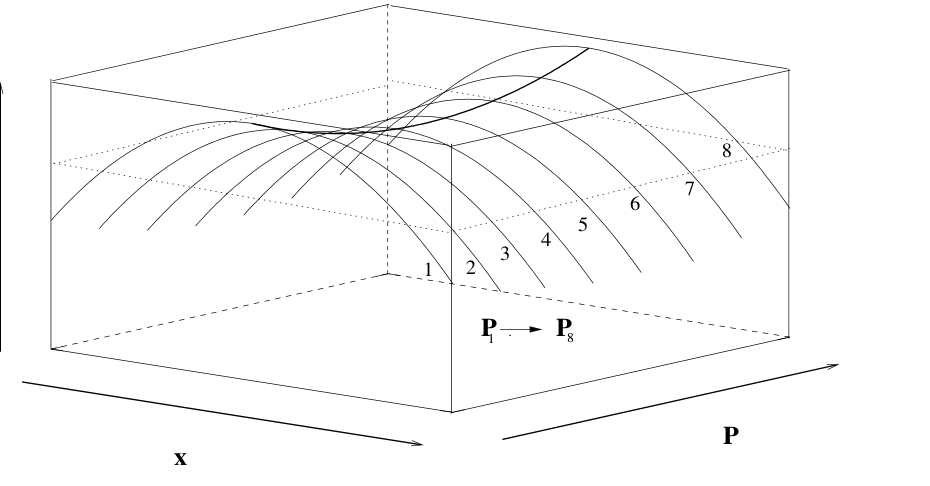
Figure 2.3. Schematic three-dimensional T–p–x phase diagram of a substance with an upper critical point; P₁ through P₈ indicate increasing pressure.
2.2 Critical Phenomena
2.2.1 Critical Exponents and Order Parameters
As already mentioned in Section 2.1.2, continuous phase transitions, and therefore critical systems, are of particular interest because certain quantities exhibit remarkable universality near the critical point. The region of so-called critical fluctuations, discussed later in Chapter 3, is especially interesting from a physical perspective. These fluctuations are expected in the temperature range:

Original footnote: Fluctuations are deviations of the instantaneous value of a quantity from its mean, as functions of position and time.