2.2.3 Dynamic Scaling Hypothesis
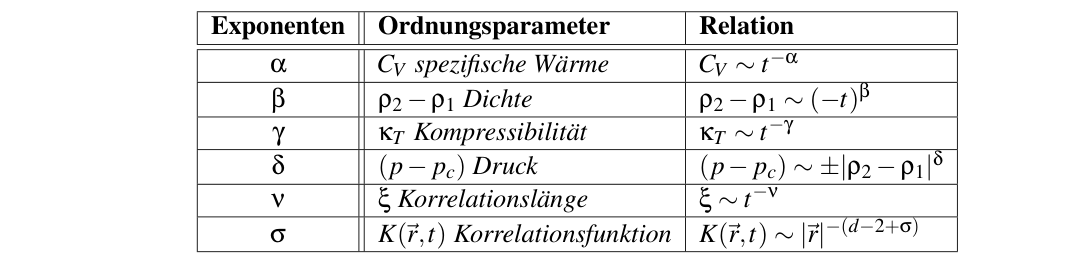
Table 2.1. Various critical exponents and the corresponding order parameters of the static scaling hypothesis.

A more detailed discussion can be found in [6].
A description of critical systems based solely on the static scaling hypothesis reveals a limitation, particularly when processes very close to the critical point are considered. Here one encounters the phenomenon known as critical slowing down: all transport processes in fluid systems slow down dramatically.
Critical fluctuations are characterized by an increase in their spatial extent and a slowing of their temporal evolution. Static scaling accounts for the length scale but not the time scale, and therefore cannot describe critical slowing down. The growth in spatial extent is characterized by the correlation length ξ, which is also associated with the slowing of transport processes in the liquid.
The static scaling theory must consequently be extended by a temporal quantity: the relaxation time τ, the time required for a system to approach equilibrium. Van Hove was the first to relate the correlation length and relaxation time through τ ∼ ξz. The theoretical development of dynamic scaling is extensive and complex; only the points needed for the present investigation are introduced here.