Handling nitromethane with silicone- or PVC-based materials (tubes, sealing rings, etc.) is very difficult. Any diffusion into these materials or their dissolution strongly affects the mole fraction and thus shifts the demixing point of the nitromethane–pentanol solution. To illustrate the problem, the effect of a percentage loss of nitromethane through diffusion into tubing on this sensitive binary mixture is shown below. Table 5.2 demonstrates the shift of the demixing point along the binodal.
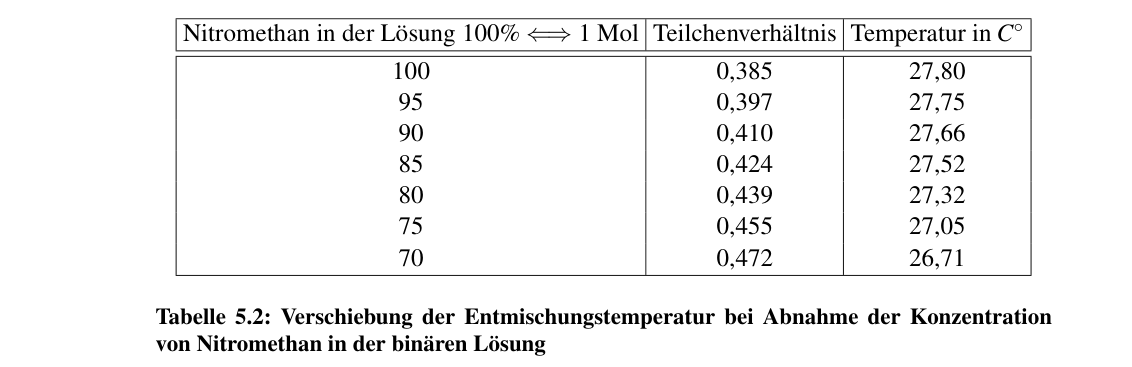
Table 5.2. Shift in demixing temperature as the nitromethane concentration in the binary solution decreases. The first column gives the remaining nitromethane relative to the initial amount, the second the mole fraction, and the third the temperature in °C.
No empirical statement can be made here about shifts in the demixing point caused by contamination from dissolved materials, since such investigations were not carried out in this work. Qualitatively, any foreign particles may affect nucleation during a liquid–liquid phase transition, which could in turn shift the demixing temperature.
The only way to avoid these effects is to prepare the measuring apparatus using materials resistant to nitromethane, such as Teflon.
2. 1-Pentanol and 1-Butanol
Handling these substances was relatively straightforward compared with nitromethane. The main concern was potential health hazards. Work with all three substances should be performed with the fume hood operating.
5.2 Preparation of the Measuring Substance
One essential quantity defining a binary critical system is the particle-number ratio, or mole fraction. As already discussed in Chapter 2, the particle-number ratio is defined as follows (continued on the next page).
Original mathematical notation is preserved in the extracted image assets.