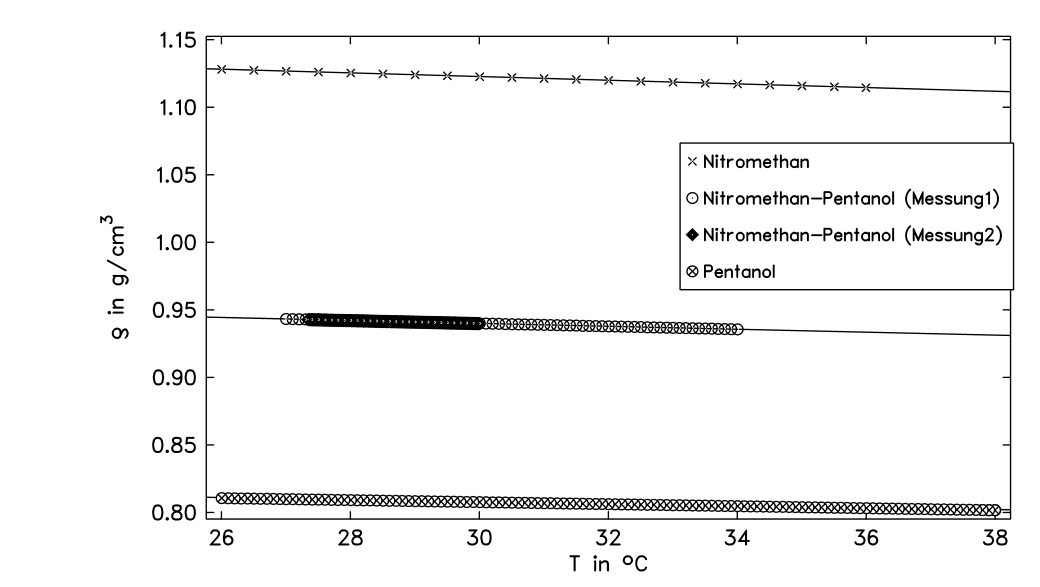
Figure 5.3. Density of the critical binary mixture and its components: measurement 1 (0.1 °C steps, 34–27 °C); measurement 2 (0.01 °C steps, 30–27.5 °C).
Figure 5.4 shows density measurements a), b), c) and d) without additional external temperature control. As is readily apparent, particularly in measurements b) and c), an almost immediate concentration change occurs when the additional temperature control is switched off. Since the trend is toward the density of nitromethane, it is reasonable to assume that the sample becomes richer in nitromethane.
The behaviour can be explained by the formation of a flow caused by cooling of the liquid in the syringe and at the open end. Material that has separated into phases in the external region enters the measurement volume. In the present experiment, this is apparently nitromethane, explaining the sudden increase in density toward the nitromethane value. The density of 1-butanol was also measured because it is a reference substance (Fig. 5.5).
Viscosity measurements were performed using a HAAKE falling-ball viscometer. The measured values are shown in Figure 5.6, where the dynamic viscosity is plotted. However, the result of a falling-ball viscometer measurement is the kinematic viscosity. The two quantities are related by:

Dynamic viscosity is also referred to as shear viscosity ηs. The background contribution—corresponding to the purely thermodynamic, noncritical behaviour of the viscosity—can be described by the following relation (continued on the next page).
Original mathematical notation and figures are preserved as extracted image assets.