Original English dissertation · scientific equations reproduced directly from the source PDF.
2 Thermodynamics of Critical Phenomena
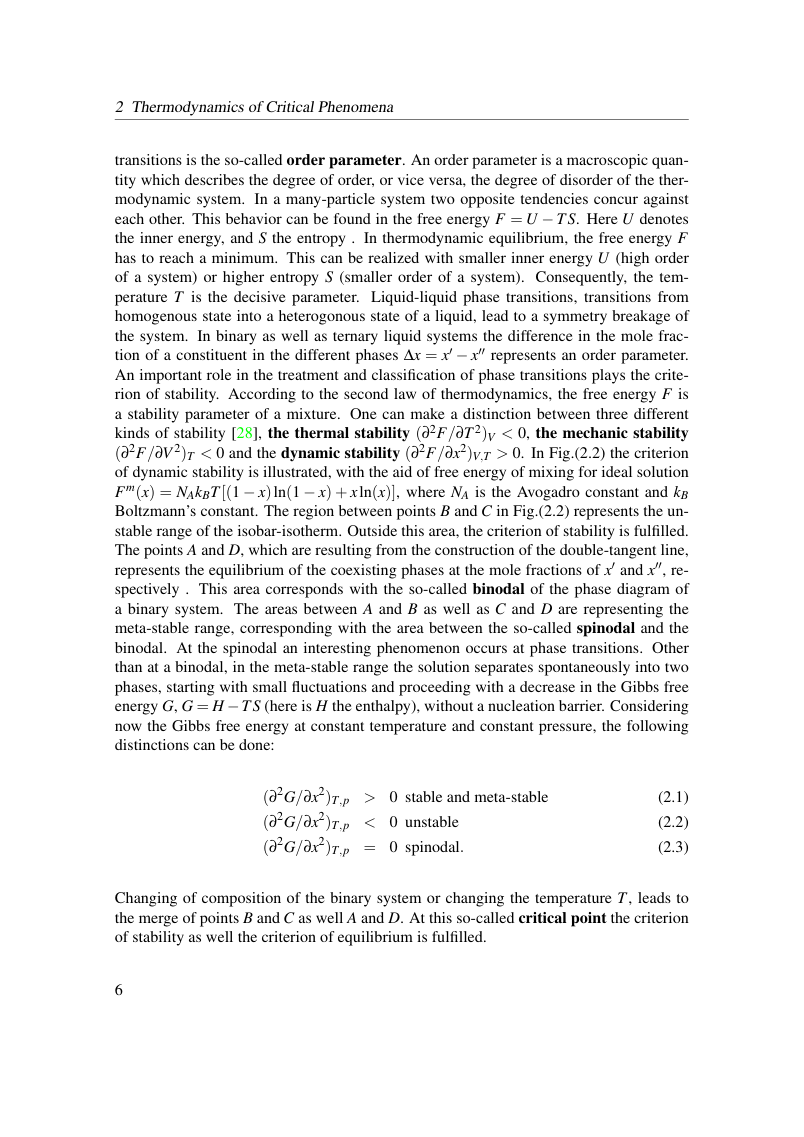
transitions is the so-called order parameter. An order parameter is a macroscopic quan- tity which describes the degree of order, or vice versa, the degree of disorder of the ther- modynamic system. In a many-particle system two opposite tendencies concur against each other. This behavior can be found in the free energy F = U −TS. Here U denotes the inner energy, and S the entropy . In thermodynamic equilibrium, the free energy F has to reach a minimum. This can be realized with smaller inner energy U (high order of a system) or higher entropy S (smaller order of a system). Consequently, the tem- perature T is the decisive parameter. Liquid-liquid phase transitions, transitions from homogenous state into a heterogonous state of a liquid, lead to a symmetry breakage of the system. In binary as well as ternary liquid systems the difference in the mole frac- tion of a constituent in the different phases ∆x = x′ −x′′ represents an order parameter. An important role in the treatment and classification of phase transitions plays the crite- rion of stability. According to the second law of thermodynamics, the free energy F is a stability parameter of a mixture. One can make a distinction between three different kinds of stability [28], the thermal stability (∂2F/∂T 2)V < 0, the mechanic stability (∂2F/∂V 2)T < 0 and the dynamic stability (∂2F/∂x2)V,T > 0. In Fig.(2.2) the criterion of dynamic stability is illustrated, with the aid of free energy of mixing for ideal solution Fm(x) = NAkBT[(1 −x)ln(1 −x) + xln(x)], where NA is the Avogadro constant and kB Boltzmann’s constant. The region between points B and C in Fig.(2.2) represents the un- stable range of the isobar-isotherm. Outside this area, the criterion of stability is fulfilled. The points A and D, which are resulting from the construction of the double-tangent line, represents the equilibrium of the coexisting phases at the mole fractions of x′ and x′′, re- spectively . This area corresponds with the so-called binodal of the phase diagram of a binary system. The areas between A and B as well as C and D are representing the meta-stable range, corresponding with the area between the so-called spinodal and the binodal. At the spinodal an interesting phenomenon occurs at phase transitions. Other than at a binodal, in the meta-stable range the solution separates spontaneously into two phases, starting with small fluctuations and proceeding with a decrease in the Gibbs free energy G, G = H −TS (here is H the enthalpy), without a nucleation barrier. Considering now the Gibbs free energy at constant temperature and constant pressure, the following distinctions can be done:



Changing of composition of the binary system or changing the temperature T, leads to the merge of points B and C as well A and D. At this so-called critical point the criterion of stability as well the criterion of equilibrium is fulfilled.
View original page 12 (authoritative equations, figures and layout)
Original dissertation · PDF page 12 · reader page 5 of 132