Original English dissertation · scientific equations reproduced directly from the source PDF.
2.3 Critical phenomena
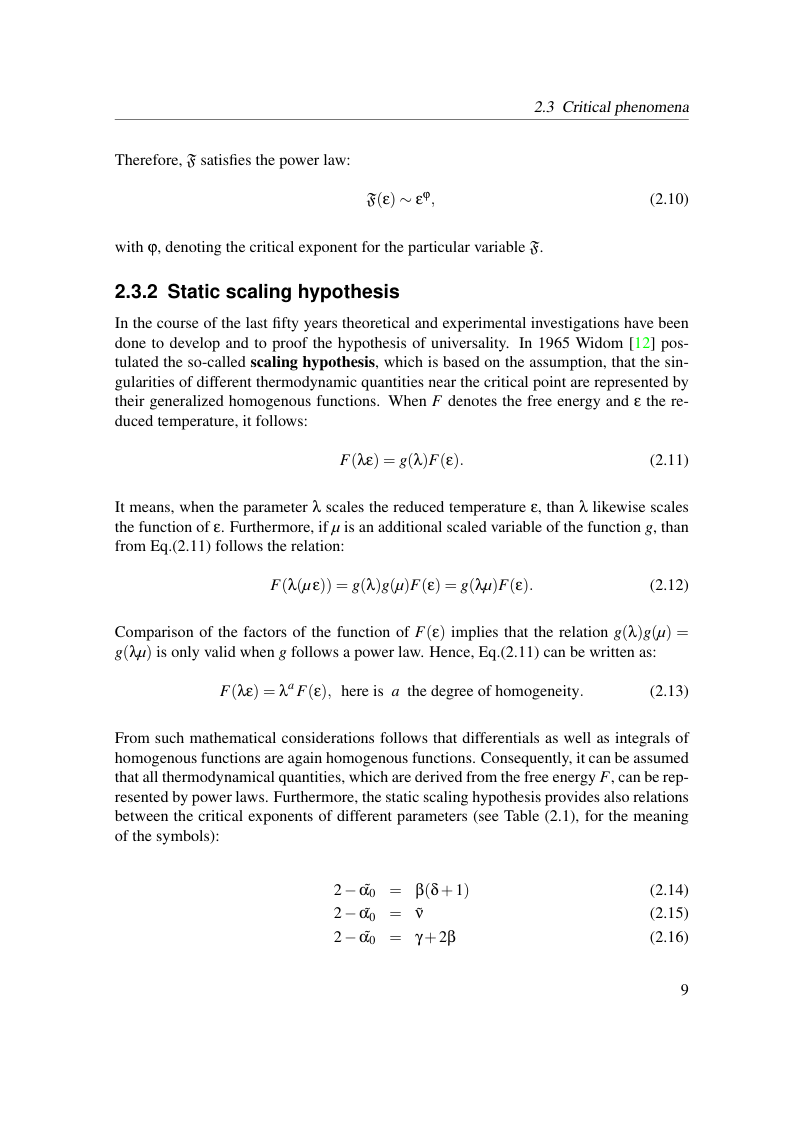
Therefore, F satisfies the power law:

with ϕ, denoting the critical exponent for the particular variable F.
2.3.2 Static scaling hypothesis
In the course of the last fifty years theoretical and experimental investigations have been done to develop and to proof the hypothesis of universality. In 1965 Widom [12] pos- tulated the so-called scaling hypothesis, which is based on the assumption, that the sin- gularities of different thermodynamic quantities near the critical point are represented by their generalized homogenous functions. When F denotes the free energy and ε the re- duced temperature, it follows:

It means, when the parameter λ scales the reduced temperature ε, than λ likewise scales the function of ε. Furthermore, if µ is an additional scaled variable of the function g, than from Eq.(2.11) follows the relation:

Comparison of the factors of the function of F(ε) implies that the relation g(λ)g(µ) = g(λµ) is only valid when g follows a power law. Hence, Eq.(2.11) can be written as:

From such mathematical considerations follows that differentials as well as integrals of homogenous functions are again homogenous functions. Consequently, it can be assumed that all thermodynamical quantities, which are derived from the free energy F, can be rep- resented by power laws. Furthermore, the static scaling hypothesis provides also relations between the critical exponents of different parameters (see Table (2.1), for the meaning of the symbols):

View original page 15 (authoritative equations, figures and layout)
Original dissertation · PDF page 15 · reader page 8 of 132