Original English dissertation · scientific equations reproduced directly from the source PDF.
2 Thermodynamics of Critical Phenomena

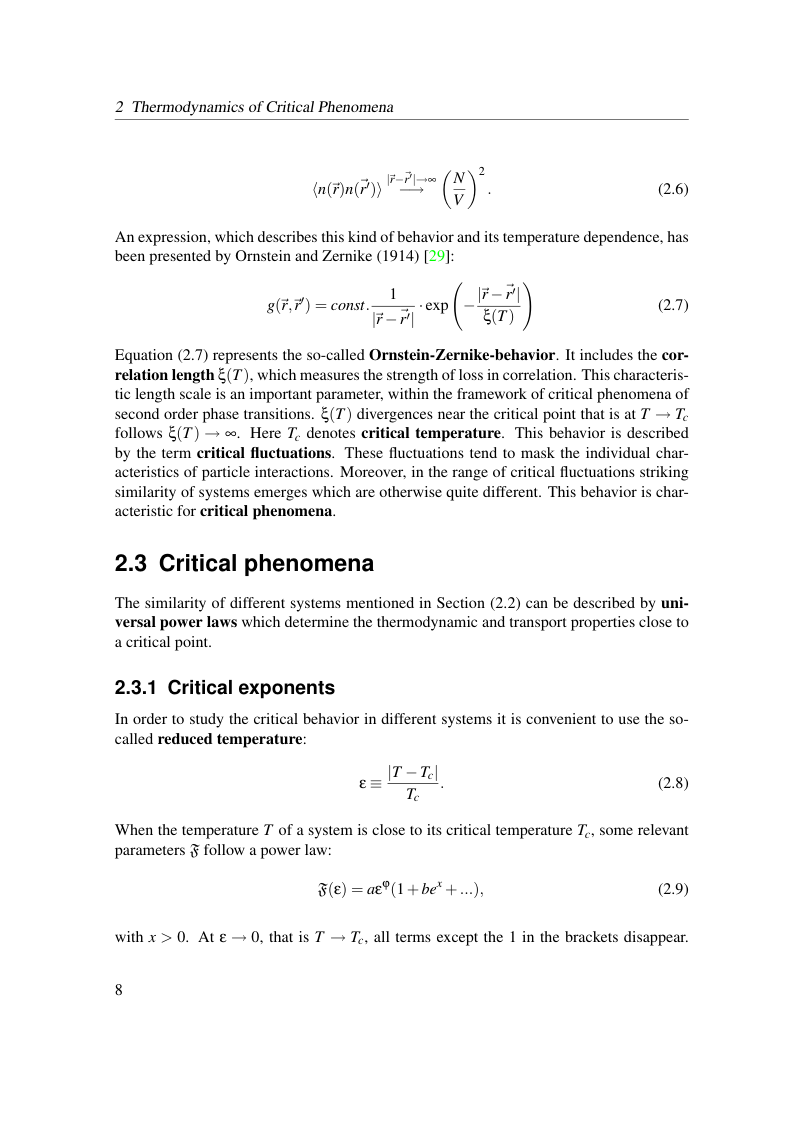
An expression, which describes this kind of behavior and its temperature dependence, has been presented by Ornstein and Zernike (1914) [29]:

Equation (2.7) represents the so-called Ornstein-Zernike-behavior. It includes the cor- relation length ξ(T), which measures the strength of loss in correlation. This characteris- tic length scale is an important parameter, within the framework of critical phenomena of second order phase transitions. ξ(T) divergences near the critical point that is at T →Tc follows ξ(T) →∞. Here Tc denotes critical temperature. This behavior is described by the term critical fluctuations. These fluctuations tend to mask the individual char- acteristics of particle interactions. Moreover, in the range of critical fluctuations striking similarity of systems emerges which are otherwise quite different. This behavior is char- acteristic for critical phenomena.
2.3 Critical phenomena
The similarity of different systems mentioned in Section (2.2) can be described by uni- versal power laws which determine the thermodynamic and transport properties close to a critical point.
2.3.1 Critical exponents
In order to study the critical behavior in different systems it is convenient to use the so- called reduced temperature:

When the temperature T of a system is close to its critical temperature Tc, some relevant parameters F follow a power law:

with x > 0. At ε →0, that is T →Tc, all terms except the 1 in the brackets disappear.
View original page 14 (authoritative equations, figures and layout)
Original dissertation · PDF page 14 · reader page 7 of 132