4.6 Light-scattering apparatus
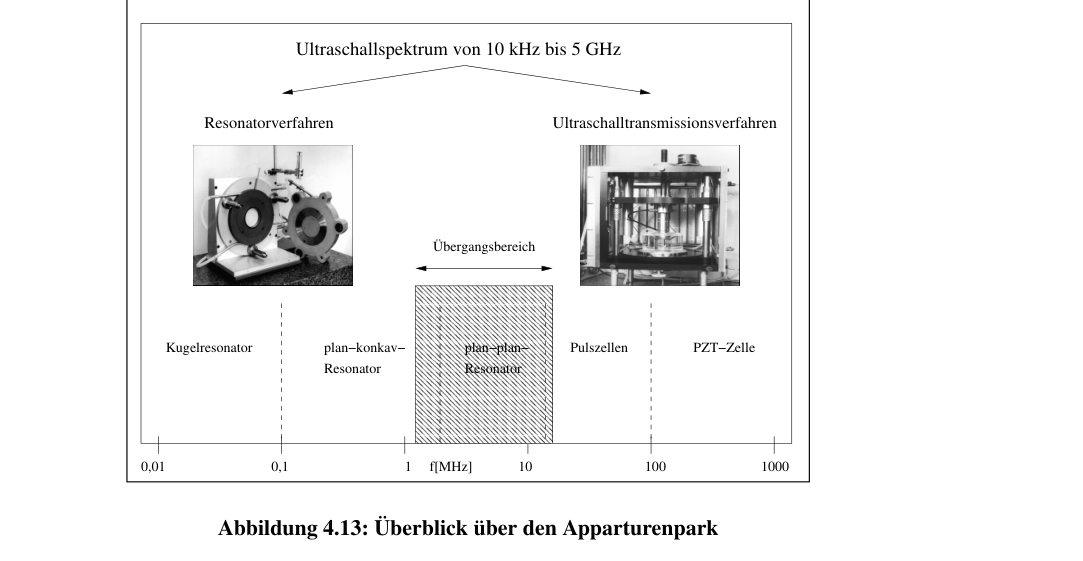
Figure 4.13. Overview of the available ultrasound equipment, covering frequencies from 10 kHz to 5 GHz, including resonator and ultrasound-transmission methods.
The approaches described in Section 3.2 for determining the required measurement parameters of a solution must now be implemented experimentally. Figure 4.14 shows the basic configuration of the light-scattering apparatus used. The wavelength of the Nd:YAG laser is λ₀ = 523 nm. Temperature is measured directly inside the cuvette.
For typical critical fluctuations, the half-width of the Rayleigh line is expected to lie in the region of 10 MHz. Optical mixing is therefore required, since frequency shifts of this magnitude cannot be resolved directly by optical means. Three methods of optical mixing are distinguished, depending on the problem:
- Self-beating method
- Homodyne mixing
- Heterodyne mixing
The method relevant to this work is self-beating.
4.6.1 Self-beating spectroscopy
The self-beating method can be described in three stages:
Original mathematical notation and illustrations are preserved as extracted image assets.