Table 4.4 · Relative total error of the ultrasonic transmission cells
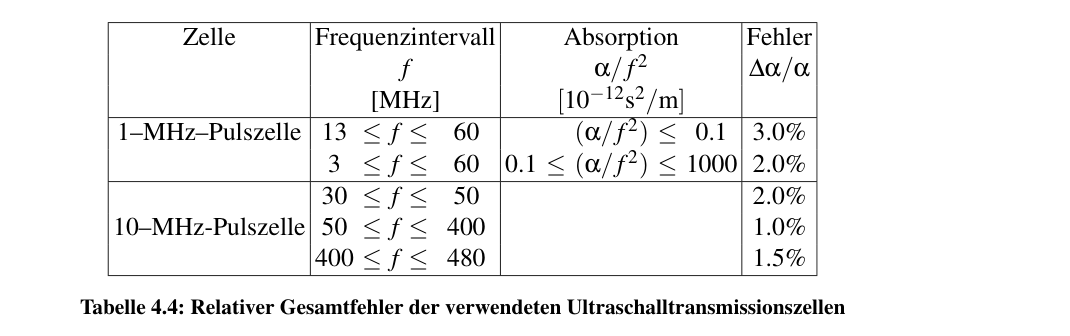
Table 4.4. Relative total error of the ultrasonic transmission cells used, as a function of frequency and reduced absorption.
A better method for precise determination of sound velocity is provided by the high-resolution sound-velocity apparatus described in [44], which was also used for measurements in the present work.
4.4.1 Design and operating principle of the sound-velocity cell
The basic idea of this apparatus is the construction of a double-resonator cell comprising a principal measuring cell and a reference cell (Figures 4.11 and 4.12). The entire measurement is performed at a selected resonance frequency. Because the sound velocity and therefore the resonance condition depend on temperature, the resonance is tracked within the scanning range as the temperature changes.
A double-resonator cell has the advantage that both resonators experience the same external conditions: they are in thermal equilibrium and are driven at the same excitation frequency. Direct comparison of the two resonances therefore yields their frequency difference, from which the temperature dependence of sound velocity can be determined.
The quartz transducers have a resonance frequency of 5 MHz. The numerous resonances near 2.5 MHz exhibit the smallest half-widths, and the principal mode is not significantly disturbed by secondary modes. This frequency range therefore promises the highest accuracy. In addition, the effective resonator length equals its geometrical length, because impedance transformation produces an acoustically rigid termination at frequencies near half the transducer resonance frequency.
If secondary modes can be neglected, the general resonance condition is

Original mathematical notation and figures are preserved in extracted image assets.