Original English dissertation · scientific equations reproduced directly from the source PDF.
2 Thermodynamics of Critical Phenomena
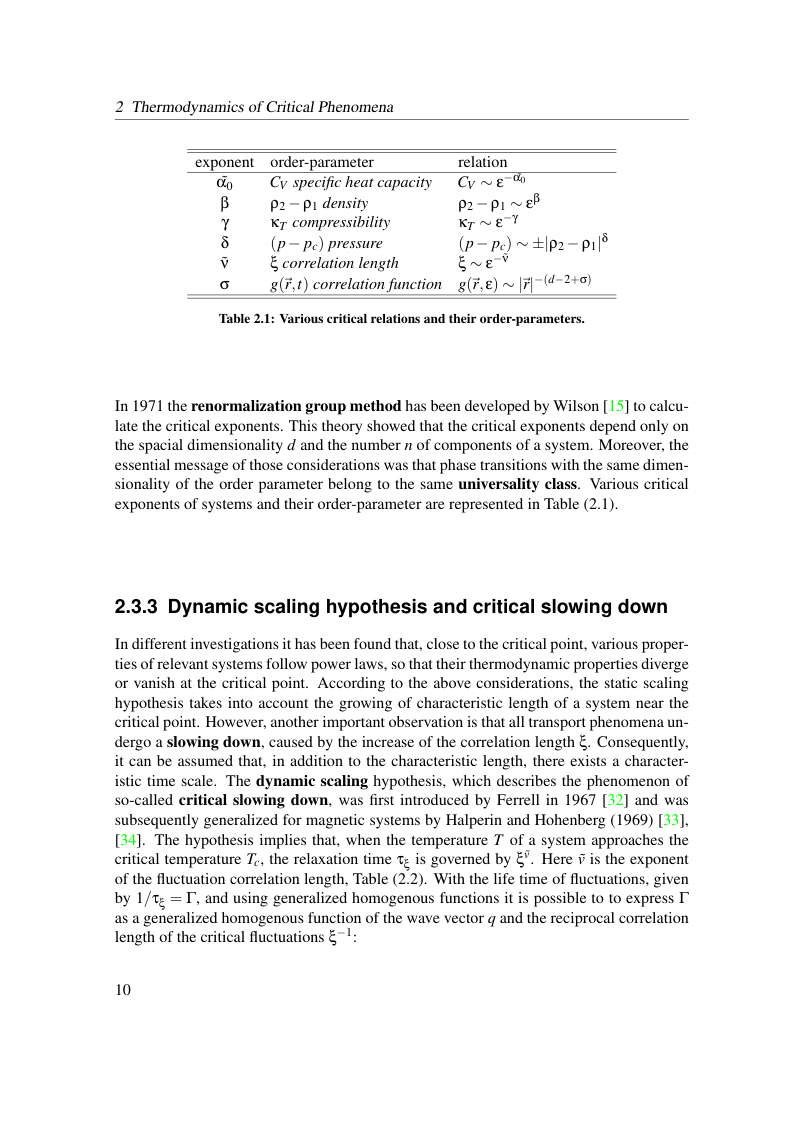
exponent order-parameter relation ˜α0 CV specific heat capacity CV ∼ε−˜α0
β ρ2 −ρ1 density ρ2 −ρ1 ∼εβ
γ κT compressibility κT ∼ε−γ
δ (p−pc) pressure (p−pc) ∼±|ρ2 −ρ1|δ
˜ν ξ correlation length ξ ∼ε−˜ν
σ g(⃗r,t) correlation function g(⃗r,ε) ∼|⃗r|−(d−2+σ)
Table 2.1: Various critical relations and their order-parameters.
In 1971 the renormalization group method has been developed by Wilson [15] to calcu- late the critical exponents. This theory showed that the critical exponents depend only on the spacial dimensionality d and the number n of components of a system. Moreover, the essential message of those considerations was that phase transitions with the same dimen- sionality of the order parameter belong to the same universality class. Various critical exponents of systems and their order-parameter are represented in Table (2.1).
2.3.3 Dynamic scaling hypothesis and critical slowing down
In different investigations it has been found that, close to the critical point, various proper- ties of relevant systems follow power laws, so that their thermodynamic properties diverge or vanish at the critical point. According to the above considerations, the static scaling hypothesis takes into account the growing of characteristic length of a system near the critical point. However, another important observation is that all transport phenomena un- dergo a slowing down, caused by the increase of the correlation length ξ. Consequently, it can be assumed that, in addition to the characteristic length, there exists a character- istic time scale. The dynamic scaling hypothesis, which describes the phenomenon of so-called critical slowing down, was first introduced by Ferrell in 1967 [32] and was subsequently generalized for magnetic systems by Halperin and Hohenberg (1969) [33], [34]. The hypothesis implies that, when the temperature T of a system approaches the critical temperature Tc, the relaxation time τξ is governed by ξ˜v. Here ˜v is the exponent of the fluctuation correlation length, Table (2.2). With the life time of fluctuations, given by 1/τξ = Γ, and using generalized homogenous functions it is possible to to express Γ as a generalized homogenous function of the wave vector q and the reciprocal correlation length of the critical fluctuations ξ−1:
View original page 16 (authoritative equations, figures and layout)
Original dissertation · PDF page 16 · reader page 9 of 132