Original English dissertation · scientific equations reproduced directly from the source PDF.
2.3 Critical phenomena
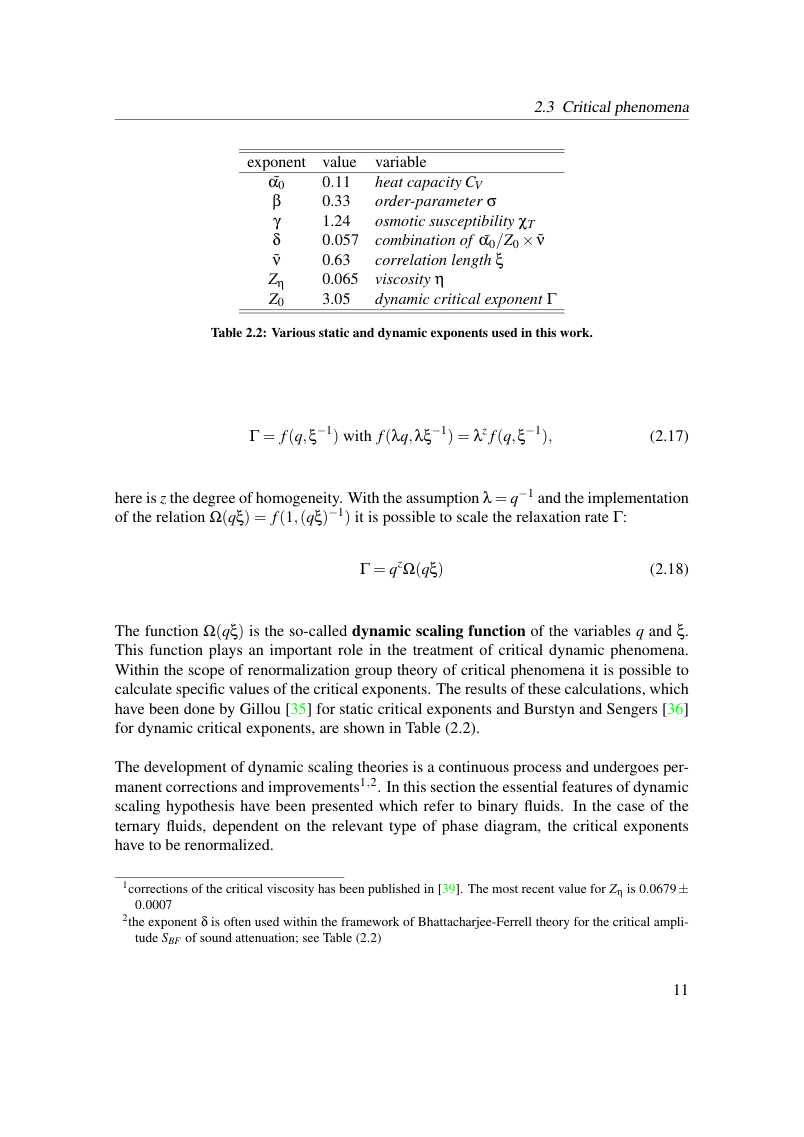
exponent value variable ˜α0 0.11 heat capacity CV β 0.33 order-parameter σ γ 1.24 osmotic susceptibility χT δ 0.057 combination of ˜α0/Z0 × ˜ν ˜ν 0.63 correlation length ξ Zη 0.065 viscosity η Z0 3.05 dynamic critical exponent Γ
Table 2.2: Various static and dynamic exponents used in this work.

here is z the degree of homogeneity. With the assumption λ = q−1 and the implementation of the relation Ω(qξ) = f(1,(qξ)−1) it is possible to scale the relaxation rate Γ:

The function Ω(qξ) is the so-called dynamic scaling function of the variables q and ξ. This function plays an important role in the treatment of critical dynamic phenomena. Within the scope of renormalization group theory of critical phenomena it is possible to calculate specific values of the critical exponents. The results of these calculations, which have been done by Gillou [35] for static critical exponents and Burstyn and Sengers [36] for dynamic critical exponents, are shown in Table (2.2).
The development of dynamic scaling theories is a continuous process and undergoes per- manent corrections and improvements1,2. In this section the essential features of dynamic scaling hypothesis have been presented which refer to binary fluids. In the case of the ternary fluids, dependent on the relevant type of phase diagram, the critical exponents have to be renormalized.
1corrections of the critical viscosity has been published in [39]. The most recent value for Zη is 0.0679± 0.0007 2the exponent δ is often used within the framework of Bhattacharjee-Ferrell theory for the critical ampli- tude SBF of sound attenuation; see Table (2.2)
View original page 17 (authoritative equations, figures and layout)
Original dissertation · PDF page 17 · reader page 10 of 132