Original English dissertation · scientific equations reproduced directly from the source PDF.
5 Experimental Verification of Dynamic Scaling Theories and Discussions
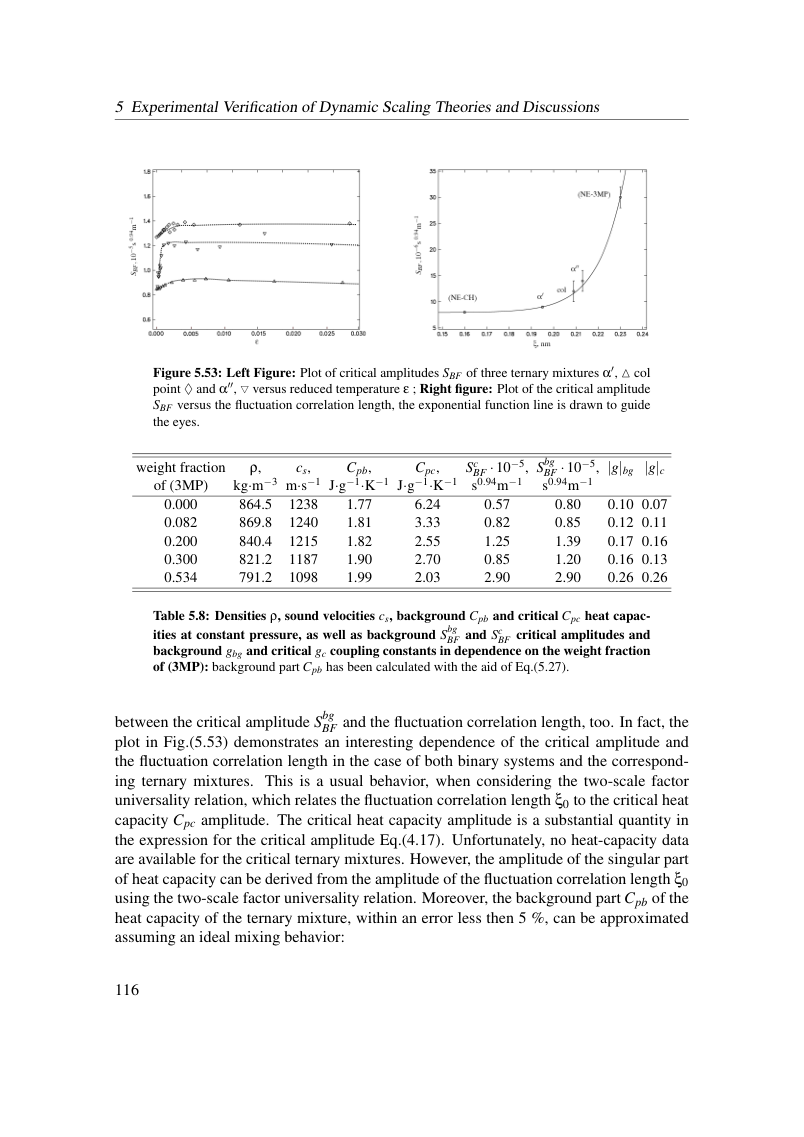
Figure 5.53: Left Figure: Plot of critical amplitudes SBF of three ternary mixtures α′, △col point ♦and α′′, ▽versus reduced temperature ε ; Right figure: Plot of the critical amplitude SBF versus the fluctuation correlation length, the exponential function line is drawn to guide the eyes.
weight fraction ρ, cs, Cpb, Cpc, Sc BF ·10−5, Sbg BF ·10−5, |g|bg |g|c of (3MP) kg·m−3 m·s−1 J·g−1·K−1 J·g−1·K−1 s0.94m−1 s0.94m−1
0.000 864.5 1238 1.77 6.24 0.57 0.80 0.10 0.07 0.082 869.8 1240 1.81 3.33 0.82 0.85 0.12 0.11 0.200 840.4 1215 1.82 2.55 1.25 1.39 0.17 0.16 0.300 821.2 1187 1.90 2.70 0.85 1.20 0.16 0.13 0.534 791.2 1098 1.99 2.03 2.90 2.90 0.26 0.26
Table 5.8: Densities ρ, sound velocities cs, background Cpb and critical Cpc heat capac- ities at constant pressure, as well as background Sbg BF and Sc BF critical amplitudes and background gbg and critical gc coupling constants in dependence on the weight fraction of (3MP): background part Cpb has been calculated with the aid of Eq.(5.27).
between the critical amplitude Sbg BF and the fluctuation correlation length, too. In fact, the plot in Fig.(5.53) demonstrates an interesting dependence of the critical amplitude and the fluctuation correlation length in the case of both binary systems and the correspond- ing ternary mixtures. This is a usual behavior, when considering the two-scale factor universality relation, which relates the fluctuation correlation length ξ0 to the critical heat capacity Cpc amplitude. The critical heat capacity amplitude is a substantial quantity in the expression for the critical amplitude Eq.(4.17). Unfortunately, no heat-capacity data are available for the critical ternary mixtures. However, the amplitude of the singular part of heat capacity can be derived from the amplitude of the fluctuation correlation length ξ0 using the two-scale factor universality relation. Moreover, the background part Cpb of the heat capacity of the ternary mixture, within an error less then 5 %, can be approximated assuming an ideal mixing behavior:
View original page 122 (authoritative equations, figures and layout)
Original dissertation · PDF page 122 · reader page 113 of 132