Original English dissertation · scientific equations reproduced directly from the source PDF.
4.3 The scaling function Fx(Ω)
later in [20]:

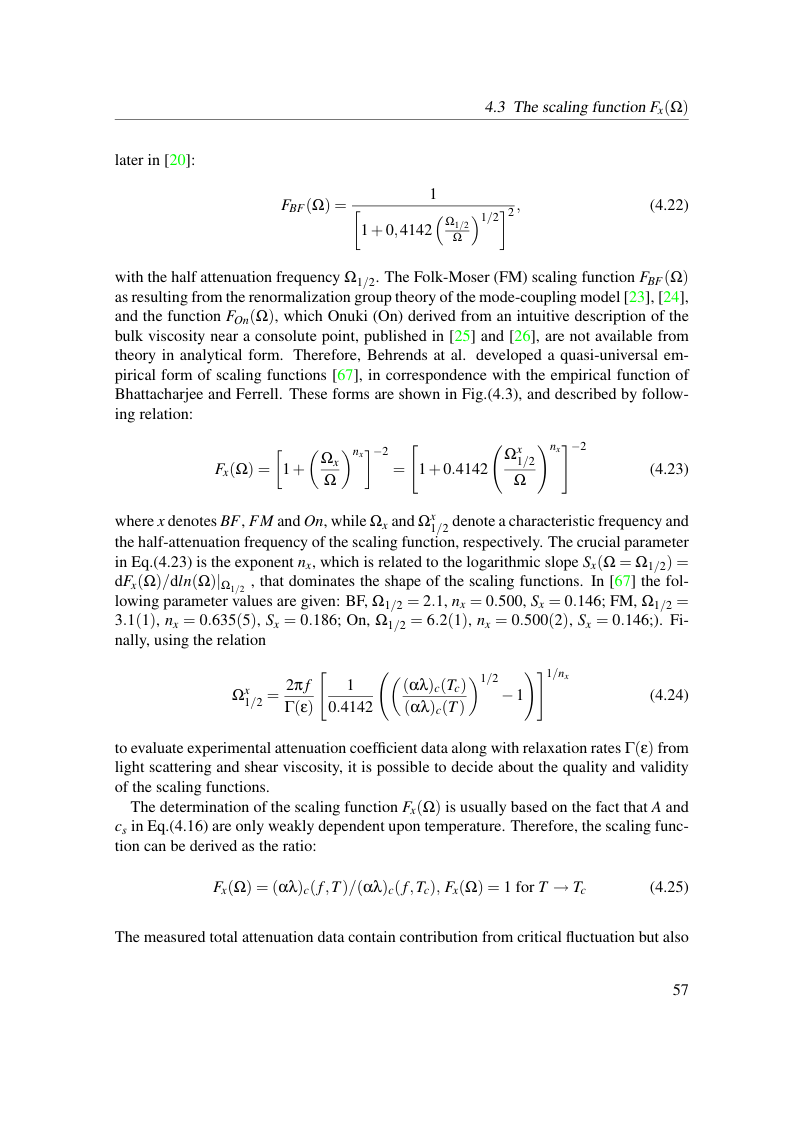
with the half attenuation frequency Ω1/2. The Folk-Moser (FM) scaling function FBF(Ω) as resulting from the renormalization group theory of the mode-coupling model [23], [24], and the function FOn(Ω), which Onuki (On) derived from an intuitive description of the bulk viscosity near a consolute point, published in [25] and [26], are not available from theory in analytical form. Therefore, Behrends at al. developed a quasi-universal em- pirical form of scaling functions [67], in correspondence with the empirical function of Bhattacharjee and Ferrell. These forms are shown in Fig.(4.3), and described by follow- ing relation:

where x denotes BF, FM and On, while Ωx and Ωx 1/2 denote a characteristic frequency and the half-attenuation frequency of the scaling function, respectively. The crucial parameter in Eq.(4.23) is the exponent nx, which is related to the logarithmic slope Sx(Ω= Ω1/2) = dFx(Ω)/dln(Ω)|Ω1/2 , that dominates the shape of the scaling functions. In [67] the fol- lowing parameter values are given: BF, Ω1/2 = 2.1, nx = 0.500, Sx = 0.146; FM, Ω1/2 = 3.1(1), nx = 0.635(5), Sx = 0.186; On, Ω1/2 = 6.2(1), nx = 0.500(2), Sx = 0.146;). Fi- nally, using the relation

to evaluate experimental attenuation coefficient data along with relaxation rates Γ(ε) from light scattering and shear viscosity, it is possible to decide about the quality and validity of the scaling functions. The determination of the scaling function Fx(Ω) is usually based on the fact that A and cs in Eq.(4.16) are only weakly dependent upon temperature. Therefore, the scaling func- tion can be derived as the ratio:

The measured total attenuation data contain contribution from critical fluctuation but also
View original page 63 (authoritative equations, figures and layout)
Original dissertation · PDF page 63 · reader page 55 of 132