Original English dissertation · scientific equations reproduced directly from the source PDF.
4.4 The crossover theory in binary mixtures
modes of the considered liquid system into those that show only short range order and high frequency fluctuations and are only weakly coupled and into such which show long range fluctuations and are coupled strongly. These last ones lead to non-analytic behavior near the consolute point. Consequently, the existence of a cut-off Λ in the wave numbers of fluctuations, has to be taken into account when fluctuation dominated behavior of the system is studied. This view has been successfully applied to the van der Waals gas.
The Crossover corrections
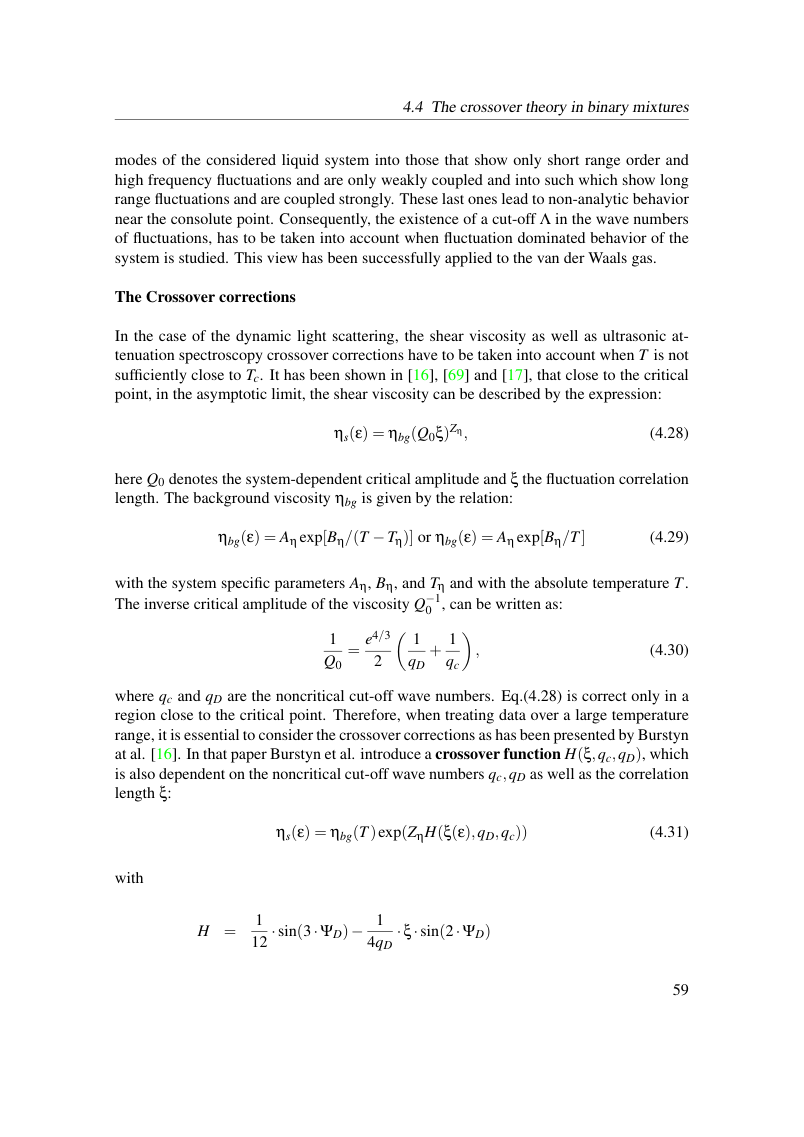
In the case of the dynamic light scattering, the shear viscosity as well as ultrasonic at- tenuation spectroscopy crossover corrections have to be taken into account when T is not sufficiently close to Tc. It has been shown in [16], [69] and [17], that close to the critical point, in the asymptotic limit, the shear viscosity can be described by the expression:

here Q0 denotes the system-dependent critical amplitude and ξ the fluctuation correlation length. The background viscosity ηbg is given by the relation:

with the system specific parameters Aη, Bη, and Tη and with the absolute temperature T. The inverse critical amplitude of the viscosity Q−1 0 , can be written as:

where qc and qD are the noncritical cut-off wave numbers. Eq.(4.28) is correct only in a region close to the critical point. Therefore, when treating data over a large temperature range, it is essential to consider the crossover corrections as has been presented by Burstyn at al. [16]. In that paper Burstyn et al. introduce a crossover function H(ξ,qc,qD), which is also dependent on the noncritical cut-off wave numbers qc,qD as well as the correlation length ξ:

with
H = 1 12 ·sin(3·ΨD)−1
4qD ·ξ·sin(2·ΨD)
View original page 65 (authoritative equations, figures and layout)
Original dissertation · PDF page 65 · reader page 57 of 132