Original English dissertation · scientific equations reproduced directly from the source PDF.
4 Critical Contribution, Dynamic Scaling and Crossover Theory
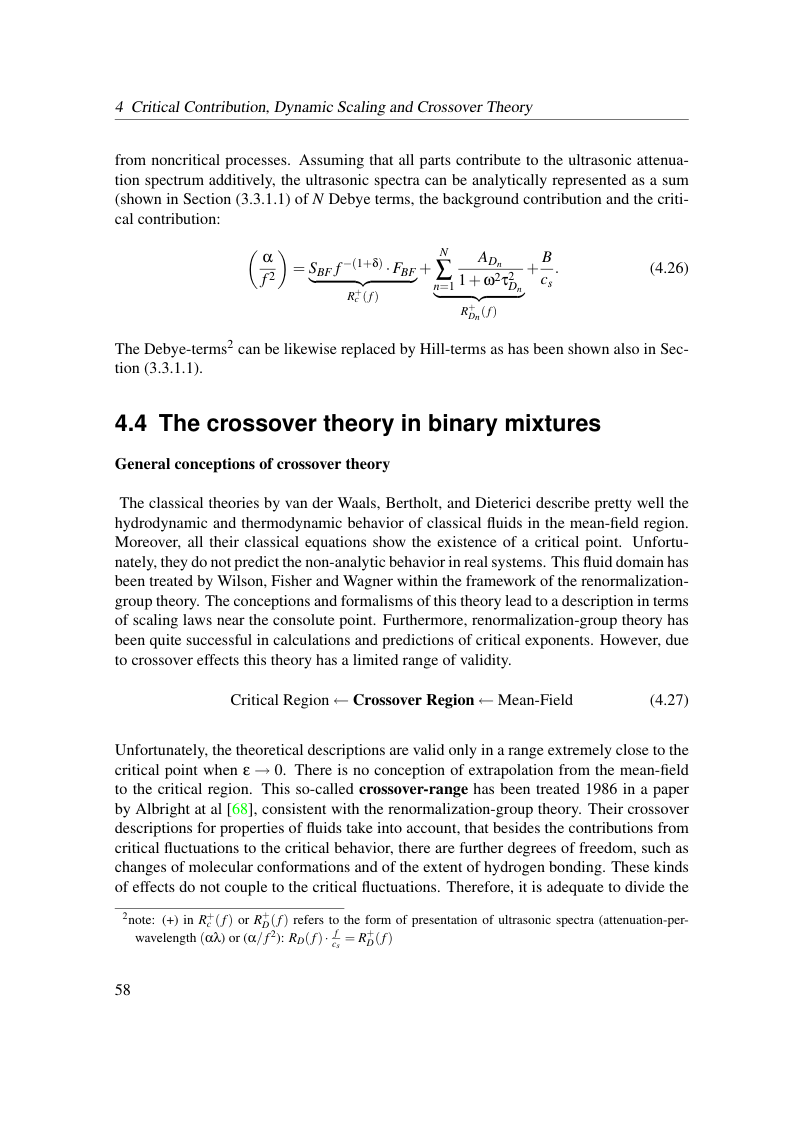
from noncritical processes. Assuming that all parts contribute to the ultrasonic attenua- tion spectrum additively, the ultrasonic spectra can be analytically represented as a sum (shown in Section (3.3.1.1) of N Debye terms, the background contribution and the criti- cal contribution:

The Debye-terms2 can be likewise replaced by Hill-terms as has been shown also in Sec- tion (3.3.1.1).
4.4 The crossover theory in binary mixtures
General conceptions of crossover theory
The classical theories by van der Waals, Bertholt, and Dieterici describe pretty well the hydrodynamic and thermodynamic behavior of classical fluids in the mean-field region. Moreover, all their classical equations show the existence of a critical point. Unfortu- nately, they do not predict the non-analytic behavior in real systems. This fluid domain has been treated by Wilson, Fisher and Wagner within the framework of the renormalization- group theory. The conceptions and formalisms of this theory lead to a description in terms of scaling laws near the consolute point. Furthermore, renormalization-group theory has been quite successful in calculations and predictions of critical exponents. However, due to crossover effects this theory has a limited range of validity.

Unfortunately, the theoretical descriptions are valid only in a range extremely close to the critical point when ε →0. There is no conception of extrapolation from the mean-field to the critical region. This so-called crossover-range has been treated 1986 in a paper by Albright at al [68], consistent with the renormalization-group theory. Their crossover descriptions for properties of fluids take into account, that besides the contributions from critical fluctuations to the critical behavior, there are further degrees of freedom, such as changes of molecular conformations and of the extent of hydrogen bonding. These kinds of effects do not couple to the critical fluctuations. Therefore, it is adequate to divide the
2note: (+) in R+ c (f) or R+ D(f) refers to the form of presentation of ultrasonic spectra (attenuation-per- wavelength (αλ) or (α/ f 2): RD(f)· f
cs = R+ D(f)
View original page 64 (authoritative equations, figures and layout)
Original dissertation · PDF page 64 · reader page 56 of 132