Original English dissertation · scientific equations reproduced directly from the source PDF.
5 Experimental Verification of Dynamic Scaling Theories and Discussions
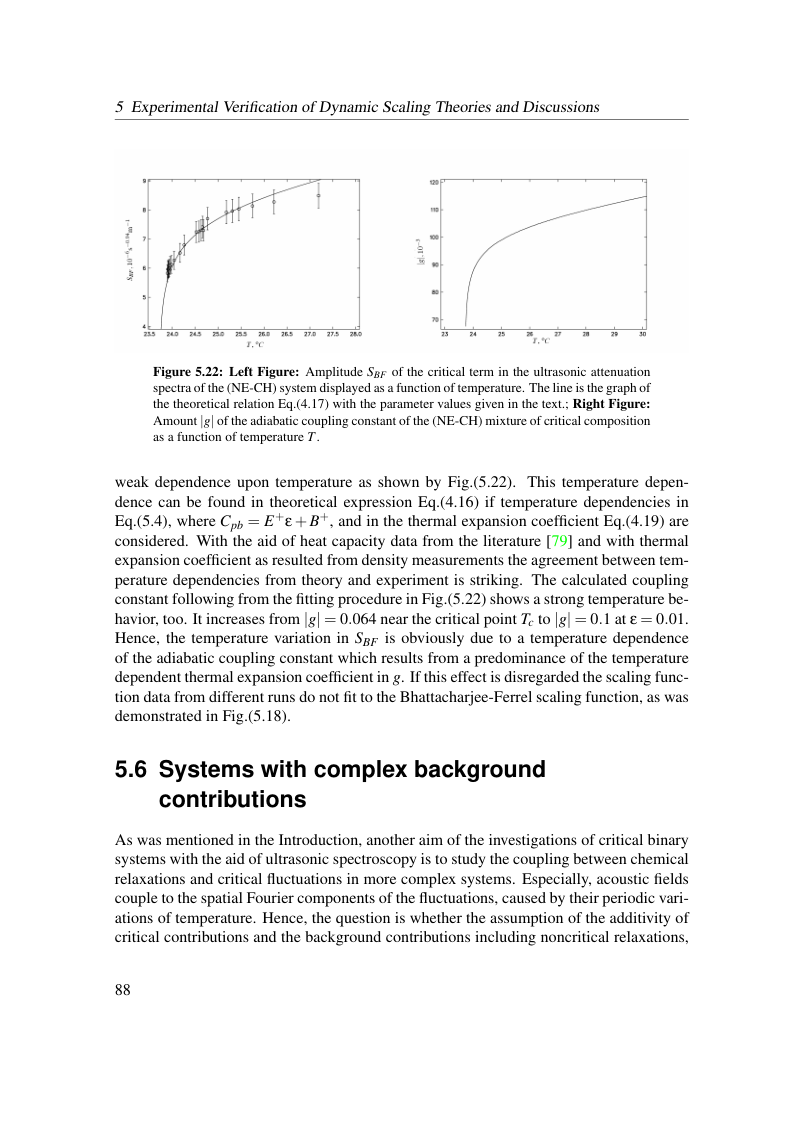
Figure 5.22: Left Figure: Amplitude SBF of the critical term in the ultrasonic attenuation spectra of the (NE-CH) system displayed as a function of temperature. The line is the graph of the theoretical relation Eq.(4.17) with the parameter values given in the text.; Right Figure: Amount |g| of the adiabatic coupling constant of the (NE-CH) mixture of critical composition as a function of temperature T.
weak dependence upon temperature as shown by Fig.(5.22). This temperature depen- dence can be found in theoretical expression Eq.(4.16) if temperature dependencies in Eq.(5.4), where Cpb = E+ε + B+, and in the thermal expansion coefficient Eq.(4.19) are considered. With the aid of heat capacity data from the literature [79] and with thermal expansion coefficient as resulted from density measurements the agreement between tem- perature dependencies from theory and experiment is striking. The calculated coupling constant following from the fitting procedure in Fig.(5.22) shows a strong temperature be- havior, too. It increases from |g| = 0.064 near the critical point Tc to |g| = 0.1 at ε = 0.01. Hence, the temperature variation in SBF is obviously due to a temperature dependence of the adiabatic coupling constant which results from a predominance of the temperature dependent thermal expansion coefficient in g. If this effect is disregarded the scaling func- tion data from different runs do not fit to the Bhattacharjee-Ferrel scaling function, as was demonstrated in Fig.(5.18).
5.6 Systems with complex background contributions
As was mentioned in the Introduction, another aim of the investigations of critical binary systems with the aid of ultrasonic spectroscopy is to study the coupling between chemical relaxations and critical fluctuations in more complex systems. Especially, acoustic fields couple to the spatial Fourier components of the fluctuations, caused by their periodic vari- ations of temperature. Hence, the question is whether the assumption of the additivity of critical contributions and the background contributions including noncritical relaxations,
View original page 94 (authoritative equations, figures and layout)
Original dissertation · PDF page 94 · reader page 85 of 132