Original English dissertation · scientific equations reproduced directly from the source PDF.
5.5 Ultrasonic spectrometry
In this example the value of the critical amplitude SBF can be derived from the ultrasonic attenuation spectroscopy, using the expression:

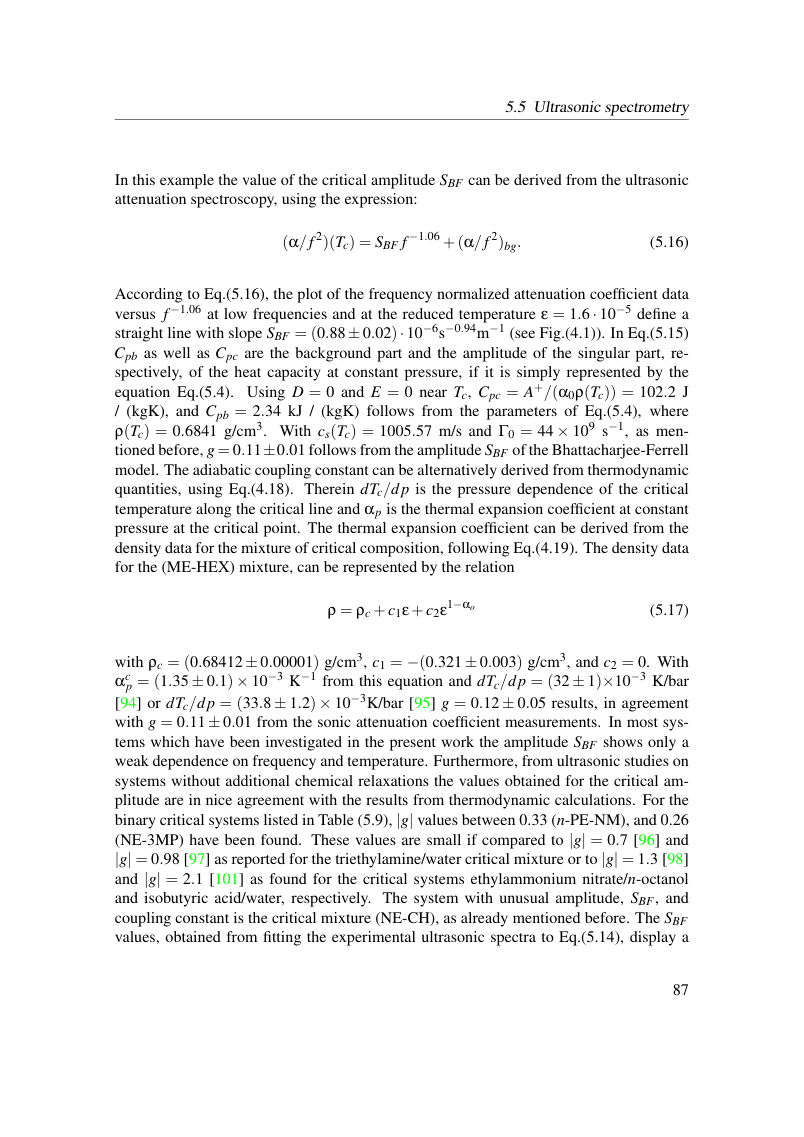
According to Eq.(5.16), the plot of the frequency normalized attenuation coefficient data versus f −1.06 at low frequencies and at the reduced temperature ε = 1.6 · 10−5 define a straight line with slope SBF = (0.88±0.02)·10−6s−0.94m−1 (see Fig.(4.1)). In Eq.(5.15) Cpb as well as Cpc are the background part and the amplitude of the singular part, re- spectively, of the heat capacity at constant pressure, if it is simply represented by the equation Eq.(5.4). Using D = 0 and E = 0 near Tc, Cpc = A+/(α0ρ(Tc)) = 102.2 J / (kgK), and Cpb = 2.34 kJ / (kgK) follows from the parameters of Eq.(5.4), where ρ(Tc) = 0.6841 g/cm3. With cs(Tc) = 1005.57 m/s and Γ0 = 44 × 109 s−1, as men- tioned before, g = 0.11±0.01 follows from the amplitude SBF of the Bhattacharjee-Ferrell model. The adiabatic coupling constant can be alternatively derived from thermodynamic quantities, using Eq.(4.18). Therein dTc/dp is the pressure dependence of the critical temperature along the critical line and αp is the thermal expansion coefficient at constant pressure at the critical point. The thermal expansion coefficient can be derived from the density data for the mixture of critical composition, following Eq.(4.19). The density data for the (ME-HEX) mixture, can be represented by the relation

with ρc = (0.68412 ± 0.00001) g/cm3, c1 = −(0.321 ± 0.003) g/cm3, and c2 = 0. With αc p = (1.35 ± 0.1) × 10−3 K−1 from this equation and dTc/dp = (32 ± 1)×10−3 K/bar [94] or dTc/dp = (33.8 ± 1.2) × 10−3K/bar [95] g = 0.12 ± 0.05 results, in agreement with g = 0.11 ± 0.01 from the sonic attenuation coefficient measurements. In most sys- tems which have been investigated in the present work the amplitude SBF shows only a weak dependence on frequency and temperature. Furthermore, from ultrasonic studies on systems without additional chemical relaxations the values obtained for the critical am- plitude are in nice agreement with the results from thermodynamic calculations. For the binary critical systems listed in Table (5.9), |g| values between 0.33 (n-PE-NM), and 0.26 (NE-3MP) have been found. These values are small if compared to |g| = 0.7 [96] and |g| = 0.98 [97] as reported for the triethylamine/water critical mixture or to |g| = 1.3 [98] and |g| = 2.1 [101] as found for the critical systems ethylammonium nitrate/n-octanol and isobutyric acid/water, respectively. The system with unusual amplitude, SBF, and coupling constant is the critical mixture (NE-CH), as already mentioned before. The SBF values, obtained from fitting the experimental ultrasonic spectra to Eq.(5.14), display a
View original page 93 (authoritative equations, figures and layout)
Original dissertation · PDF page 93 · reader page 84 of 132