Original English dissertation · scientific equations reproduced directly from the source PDF.
5.1 Strategies of verifying the scaling function
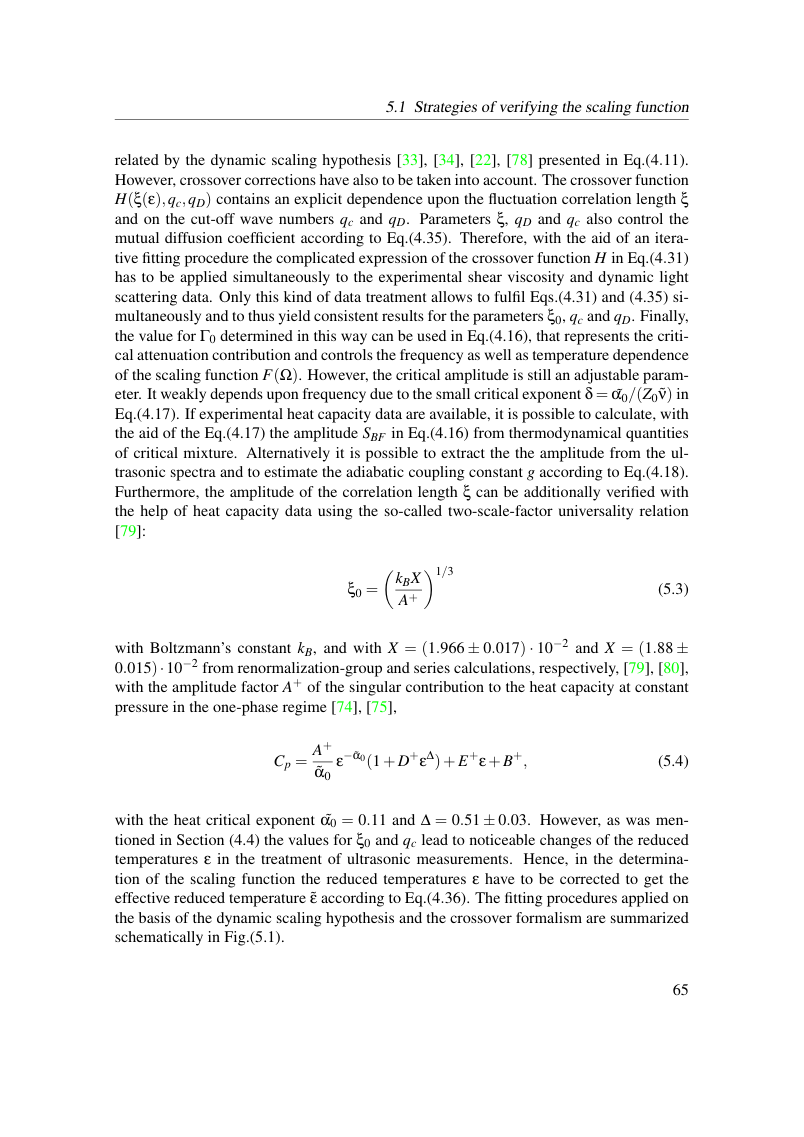
related by the dynamic scaling hypothesis [33], [34], [22], [78] presented in Eq.(4.11). However, crossover corrections have also to be taken into account. The crossover function H(ξ(ε),qc,qD) contains an explicit dependence upon the fluctuation correlation length ξ and on the cut-off wave numbers qc and qD. Parameters ξ, qD and qc also control the mutual diffusion coefficient according to Eq.(4.35). Therefore, with the aid of an itera- tive fitting procedure the complicated expression of the crossover function H in Eq.(4.31) has to be applied simultaneously to the experimental shear viscosity and dynamic light scattering data. Only this kind of data treatment allows to fulfil Eqs.(4.31) and (4.35) si- multaneously and to thus yield consistent results for the parameters ξ0, qc and qD. Finally, the value for Γ0 determined in this way can be used in Eq.(4.16), that represents the criti- cal attenuation contribution and controls the frequency as well as temperature dependence of the scaling function F(Ω). However, the critical amplitude is still an adjustable param- eter. It weakly depends upon frequency due to the small critical exponent δ = ˜α0/(Z0˜ν) in Eq.(4.17). If experimental heat capacity data are available, it is possible to calculate, with the aid of the Eq.(4.17) the amplitude SBF in Eq.(4.16) from thermodynamical quantities of critical mixture. Alternatively it is possible to extract the the amplitude from the ul- trasonic spectra and to estimate the adiabatic coupling constant g according to Eq.(4.18). Furthermore, the amplitude of the correlation length ξ can be additionally verified with the help of heat capacity data using the so-called two-scale-factor universality relation [79]:

with Boltzmann’s constant kB, and with X = (1.966 ± 0.017) · 10−2 and X = (1.88 ± 0.015)·10−2 from renormalization-group and series calculations, respectively, [79], [80], with the amplitude factor A+ of the singular contribution to the heat capacity at constant pressure in the one-phase regime [74], [75],

with the heat critical exponent ˜α0 = 0.11 and ∆= 0.51 ± 0.03. However, as was men- tioned in Section (4.4) the values for ξ0 and qc lead to noticeable changes of the reduced temperatures ε in the treatment of ultrasonic measurements. Hence, in the determina- tion of the scaling function the reduced temperatures ε have to be corrected to get the effective reduced temperature ˜ε according to Eq.(4.36). The fitting procedures applied on the basis of the dynamic scaling hypothesis and the crossover formalism are summarized schematically in Fig.(5.1).
View original page 71 (authoritative equations, figures and layout)
Original dissertation · PDF page 71 · reader page 62 of 132