Original English dissertation · scientific equations reproduced directly from the source PDF.
5 Experimental Verification of Dynamic Scaling Theories and Discussions
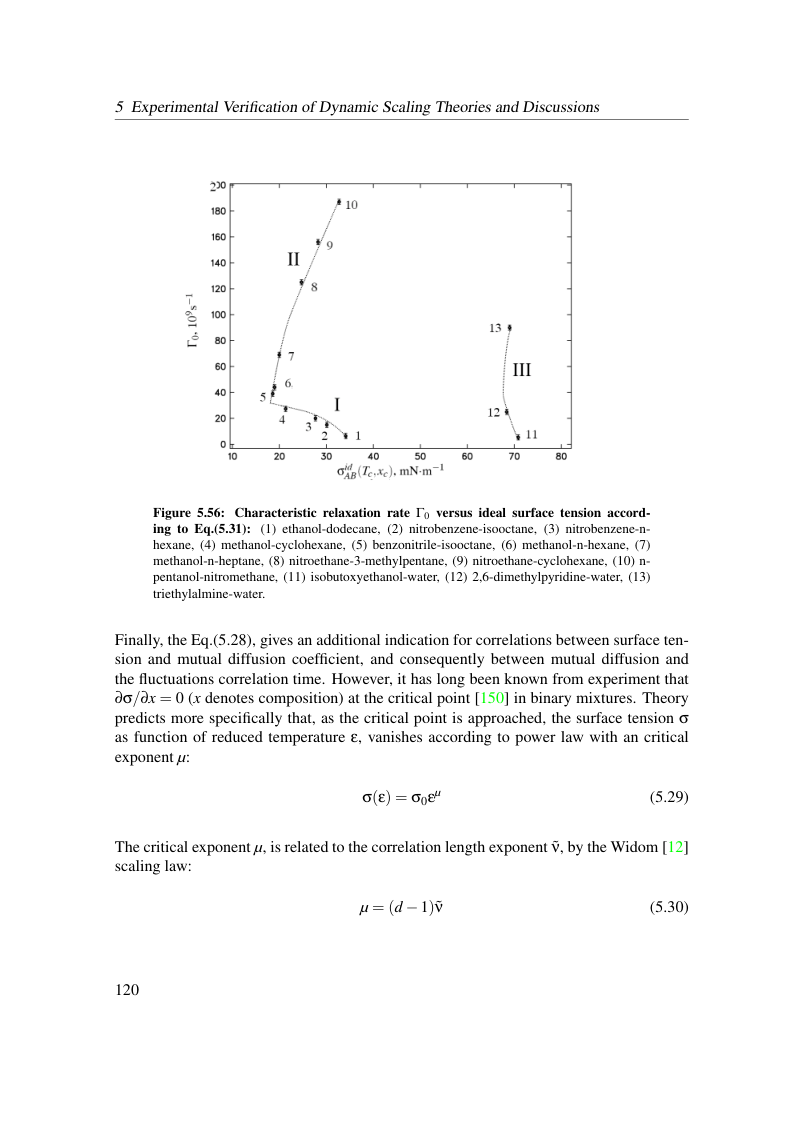
Figure 5.56: Characteristic relaxation rate Γ0 versus ideal surface tension accord- ing to Eq.(5.31): (1) ethanol-dodecane, (2) nitrobenzene-isooctane, (3) nitrobenzene-n- hexane, (4) methanol-cyclohexane, (5) benzonitrile-isooctane, (6) methanol-n-hexane, (7) methanol-n-heptane, (8) nitroethane-3-methylpentane, (9) nitroethane-cyclohexane, (10) n- pentanol-nitromethane, (11) isobutoxyethanol-water, (12) 2,6-dimethylpyridine-water, (13) triethylalmine-water.
Finally, the Eq.(5.28), gives an additional indication for correlations between surface ten- sion and mutual diffusion coefficient, and consequently between mutual diffusion and the fluctuations correlation time. However, it has long been known from experiment that ∂σ/∂x = 0 (x denotes composition) at the critical point [150] in binary mixtures. Theory predicts more specifically that, as the critical point is approached, the surface tension σ as function of reduced temperature ε, vanishes according to power law with an critical exponent µ:

The critical exponent µ, is related to the correlation length exponent ˜ν, by the Widom [12] scaling law:

View original page 126 (authoritative equations, figures and layout)
Original dissertation · PDF page 126 · reader page 117 of 132