Original English dissertation · scientific equations reproduced directly from the source PDF.
5 Experimental Verification of Dynamic Scaling Theories and Discussions
5.6.3 Triethylamine-water
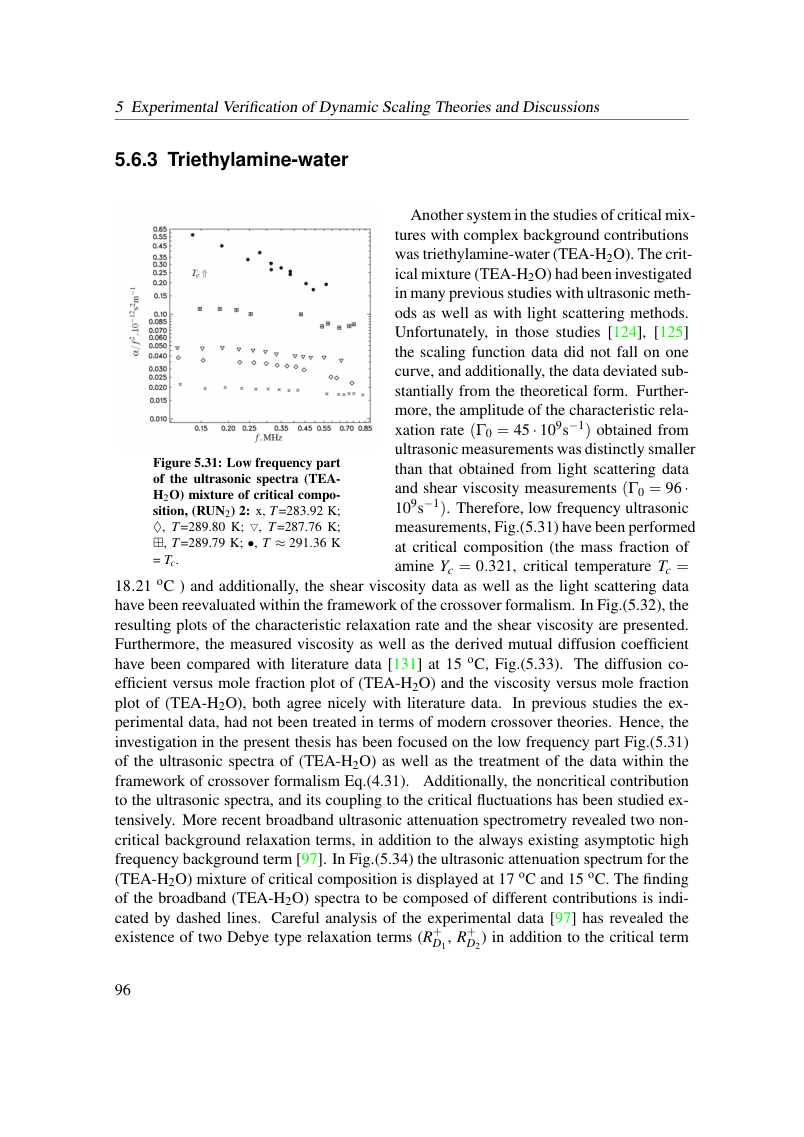
Figure 5.31: Low frequency part of the ultrasonic spectra (TEA- H2O) mixture of critical compo- sition, (RUN2) 2: x, T=283.92 K; ♦, T=289.80 K; ▽, T=287.76 K; ⊞, T=289.79 K; •, T ≈291.36 K = Tc.
Another system in the studies of critical mix- tures with complex background contributions was triethylamine-water (TEA-H2O). The crit- ical mixture (TEA-H2O) had been investigated in many previous studies with ultrasonic meth- ods as well as with light scattering methods. Unfortunately, in those studies [124], [125] the scaling function data did not fall on one curve, and additionally, the data deviated sub- stantially from the theoretical form. Further- more, the amplitude of the characteristic rela- xation rate (Γ0 = 45 · 109s−1) obtained from ultrasonic measurements was distinctly smaller than that obtained from light scattering data and shear viscosity measurements (Γ0 = 96 · 109s−1). Therefore, low frequency ultrasonic measurements, Fig.(5.31) have been performed at critical composition (the mass fraction of amine Yc = 0.321, critical temperature Tc = 18.21 oC ) and additionally, the shear viscosity data as well as the light scattering data have been reevaluated within the framework of the crossover formalism. In Fig.(5.32), the resulting plots of the characteristic relaxation rate and the shear viscosity are presented. Furthermore, the measured viscosity as well as the derived mutual diffusion coefficient have been compared with literature data [131] at 15 oC, Fig.(5.33). The diffusion co- efficient versus mole fraction plot of (TEA-H2O) and the viscosity versus mole fraction plot of (TEA-H2O), both agree nicely with literature data. In previous studies the ex- perimental data, had not been treated in terms of modern crossover theories. Hence, the investigation in the present thesis has been focused on the low frequency part Fig.(5.31) of the ultrasonic spectra of (TEA-H2O) as well as the treatment of the data within the framework of crossover formalism Eq.(4.31). Additionally, the noncritical contribution to the ultrasonic spectra, and its coupling to the critical fluctuations has been studied ex- tensively. More recent broadband ultrasonic attenuation spectrometry revealed two non- critical background relaxation terms, in addition to the always existing asymptotic high frequency background term [97]. In Fig.(5.34) the ultrasonic attenuation spectrum for the (TEA-H2O) mixture of critical composition is displayed at 17 oC and 15 oC. The finding of the broadband (TEA-H2O) spectra to be composed of different contributions is indi- cated by dashed lines. Careful analysis of the experimental data [97] has revealed the existence of two Debye type relaxation terms (R+ D1, R+ D2) in addition to the critical term
View original page 102 (authoritative equations, figures and layout)
Original dissertation · PDF page 102 · reader page 93 of 132