Original English dissertation · scientific equations reproduced directly from the source PDF.
3 Experimental Methods
Cp : specific heat capacity, p = const. CV : specific heat capacity, V = const. X : coefficient of heat conductivity.
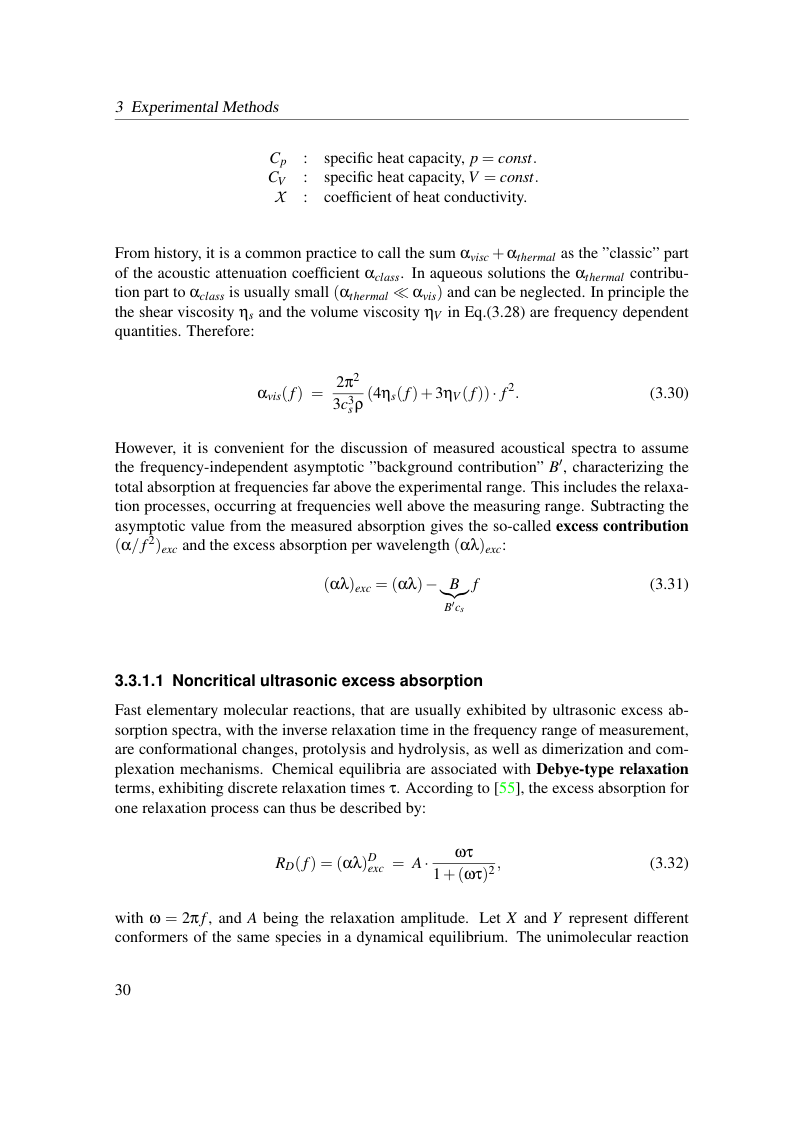
From history, it is a common practice to call the sum αvisc +αthermal as the ”classic” part of the acoustic attenuation coefficient αclass. In aqueous solutions the αthermal contribu- tion part to αclass is usually small (αthermal ≪αvis) and can be neglected. In principle the the shear viscosity ηs and the volume viscosity ηV in Eq.(3.28) are frequency dependent quantities. Therefore:

However, it is convenient for the discussion of measured acoustical spectra to assume the frequency-independent asymptotic ”background contribution” B′, characterizing the total absorption at frequencies far above the experimental range. This includes the relaxa- tion processes, occurring at frequencies well above the measuring range. Subtracting the asymptotic value from the measured absorption gives the so-called excess contribution (α/ f 2)exc and the excess absorption per wavelength (αλ)exc:

3.3.1.1 Noncritical ultrasonic excess absorption
Fast elementary molecular reactions, that are usually exhibited by ultrasonic excess ab- sorption spectra, with the inverse relaxation time in the frequency range of measurement, are conformational changes, protolysis and hydrolysis, as well as dimerization and com- plexation mechanisms. Chemical equilibria are associated with Debye-type relaxation terms, exhibiting discrete relaxation times τ. According to [55], the excess absorption for one relaxation process can thus be described by:

with ω = 2πf, and A being the relaxation amplitude. Let X and Y represent different conformers of the same species in a dynamical equilibrium. The unimolecular reaction
View original page 36 (authoritative equations, figures and layout)
Original dissertation · PDF page 36 · reader page 28 of 132