Original English dissertation · scientific equations reproduced directly from the source PDF.
3 Experimental Methods
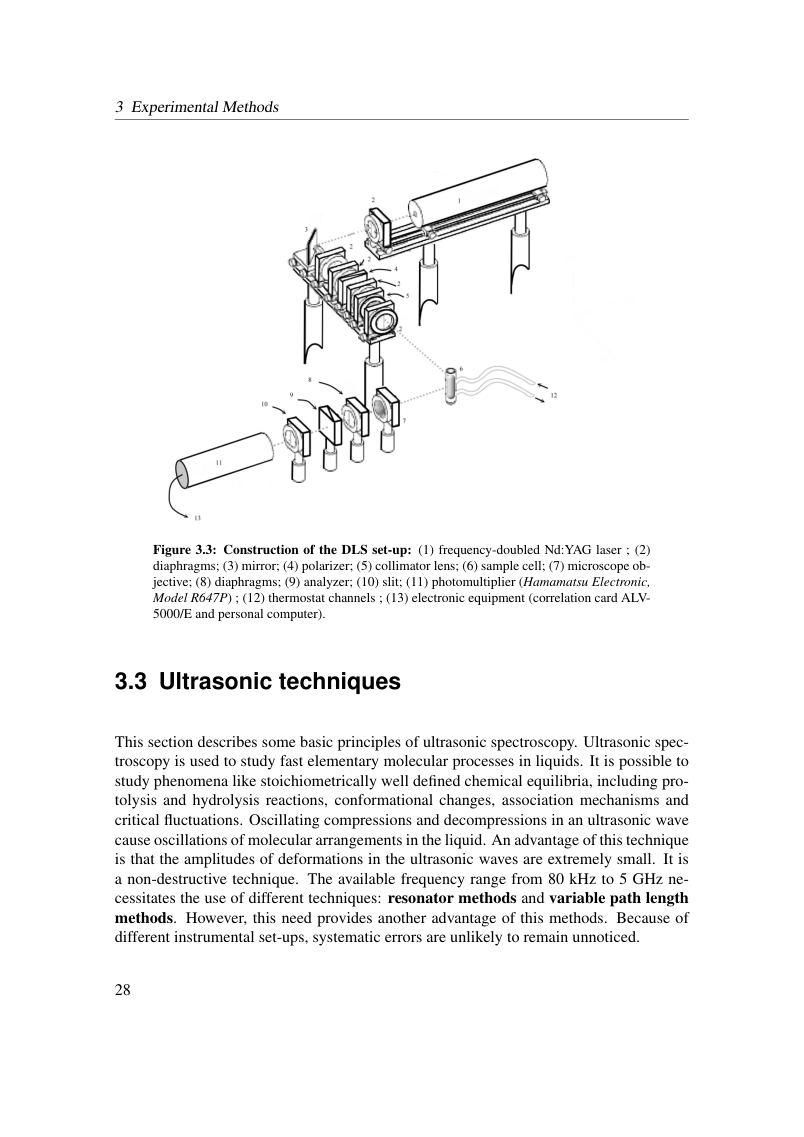
Figure 3.3: Construction of the DLS set-up: (1) frequency-doubled Nd:YAG laser ; (2) diaphragms; (3) mirror; (4) polarizer; (5) collimator lens; (6) sample cell; (7) microscope ob- jective; (8) diaphragms; (9) analyzer; (10) slit; (11) photomultiplier (Hamamatsu Electronic, Model R647P) ; (12) thermostat channels ; (13) electronic equipment (correlation card ALV- 5000/E and personal computer).
3.3 Ultrasonic techniques
This section describes some basic principles of ultrasonic spectroscopy. Ultrasonic spec- troscopy is used to study fast elementary molecular processes in liquids. It is possible to study phenomena like stoichiometrically well defined chemical equilibria, including pro- tolysis and hydrolysis reactions, conformational changes, association mechanisms and critical fluctuations. Oscillating compressions and decompressions in an ultrasonic wave cause oscillations of molecular arrangements in the liquid. An advantage of this technique is that the amplitudes of deformations in the ultrasonic waves are extremely small. It is a non-destructive technique. The available frequency range from 80 kHz to 5 GHz ne- cessitates the use of different techniques: resonator methods and variable path length methods. However, this need provides another advantage of this methods. Because of different instrumental set-ups, systematic errors are unlikely to remain unnoticed.
View original page 34 (authoritative equations, figures and layout)
Original dissertation · PDF page 34 · reader page 26 of 132