Original English dissertation · scientific equations reproduced directly from the source PDF.
3 Experimental Methods
A time lag between pressure and density in the sound field leads to a dissipation of acous- tic energy with an attenuation coefficient α in Eq.(3.27). At f ≪(2πτ)−1 the system has sufficient time to reach the equilibrium without significant decay. At high frequencies f ≫(2πτ)−1, the system can not follow the rapid pressure variations. In the frequency range f ≃(2πτ)−1, sound energy dissipation per cycle has a maximum, leading to the characteristic profile of Debye term. The unique Debye term fits spectra pretty good in case of well defined molecular processes. Sometimes it is not possible to describe an excess absorbtion spectrum by one Debye term of the form Eq.(3.32). Especially, when different molecular processes exist in the frequency range of measurement it is mostly necessary and possible to apply a sum of Debye terms:

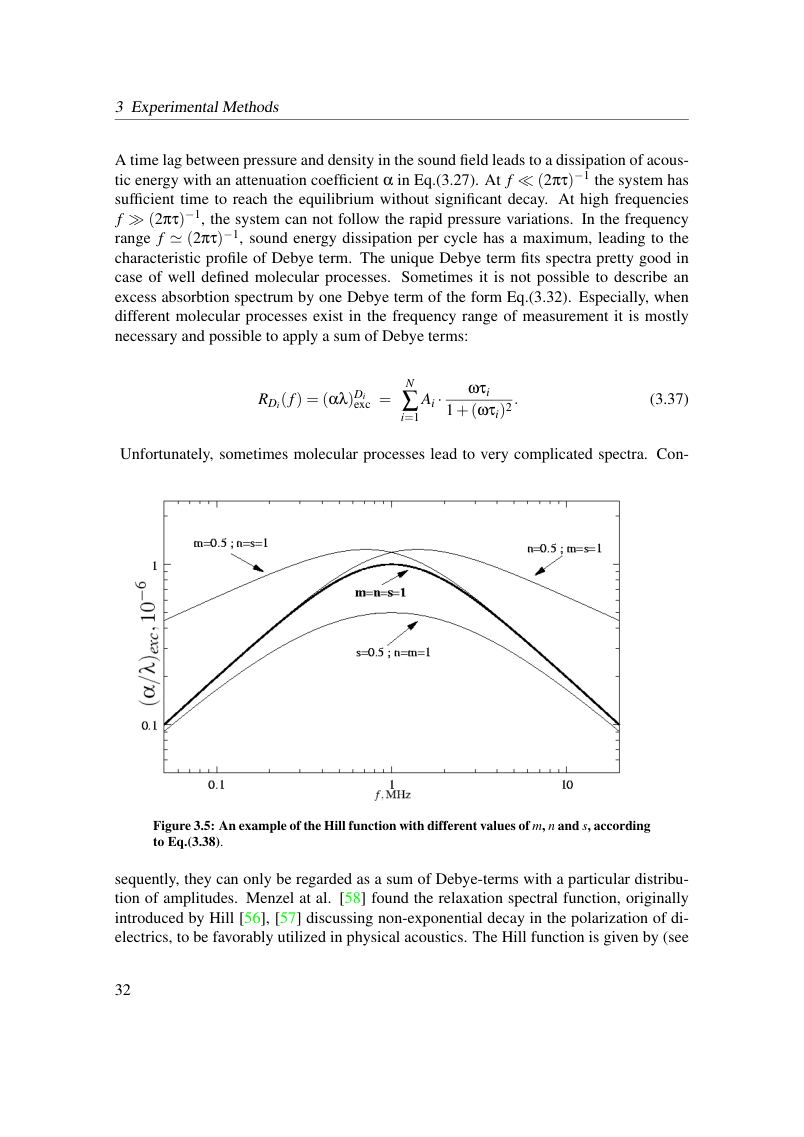
Unfortunately, sometimes molecular processes lead to very complicated spectra. Con-
Figure 3.5: An example of the Hill function with different values of m, n and s, according to Eq.(3.38).
sequently, they can only be regarded as a sum of Debye-terms with a particular distribu- tion of amplitudes. Menzel at al. [58] found the relaxation spectral function, originally introduced by Hill [56], [57] discussing non-exponential decay in the polarization of di- electrics, to be favorably utilized in physical acoustics. The Hill function is given by (see
View original page 38 (authoritative equations, figures and layout)
Original dissertation · PDF page 38 · reader page 30 of 132