Original English dissertation · scientific equations reproduced directly from the source PDF.
3.3 Ultrasonic techniques
scheme is then simply given by:

Here k f denotes the forward rate constant and kr represents the reverse rate constant. Both constant are related to the equilibrium constant K = k f /kr and to the relaxation time of Eq.(3.32) by:

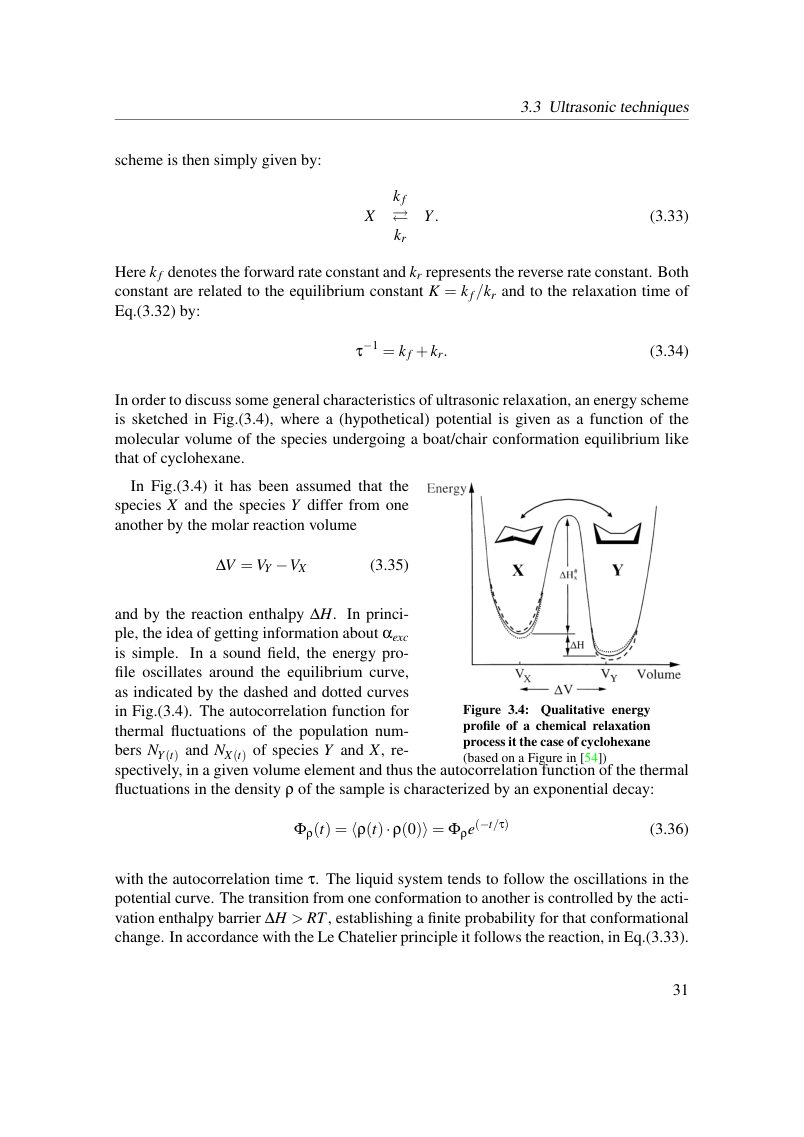
In order to discuss some general characteristics of ultrasonic relaxation, an energy scheme is sketched in Fig.(3.4), where a (hypothetical) potential is given as a function of the molecular volume of the species undergoing a boat/chair conformation equilibrium like that of cyclohexane.
In Fig.(3.4) it has been assumed that the species X and the species Y differ from one another by the molar reaction volume

Figure 3.4: Qualitative energy profile of a chemical relaxation process it the case of cyclohexane (based on a Figure in [54])
and by the reaction enthalpy ∆H. In princi- ple, the idea of getting information about αexc is simple. In a sound field, the energy pro- file oscillates around the equilibrium curve, as indicated by the dashed and dotted curves in Fig.(3.4). The autocorrelation function for thermal fluctuations of the population num- bers NY(t) and NX(t) of species Y and X, re- spectively, in a given volume element and thus the autocorrelation function of the thermal fluctuations in the density ρ of the sample is characterized by an exponential decay:

with the autocorrelation time τ. The liquid system tends to follow the oscillations in the potential curve. The transition from one conformation to another is controlled by the acti- vation enthalpy barrier ∆H > RT, establishing a finite probability for that conformational change. In accordance with the Le Chatelier principle it follows the reaction, in Eq.(3.33).
View original page 37 (authoritative equations, figures and layout)
Original dissertation · PDF page 37 · reader page 29 of 132