Original English dissertation · scientific equations reproduced directly from the source PDF.
3 Experimental Methods
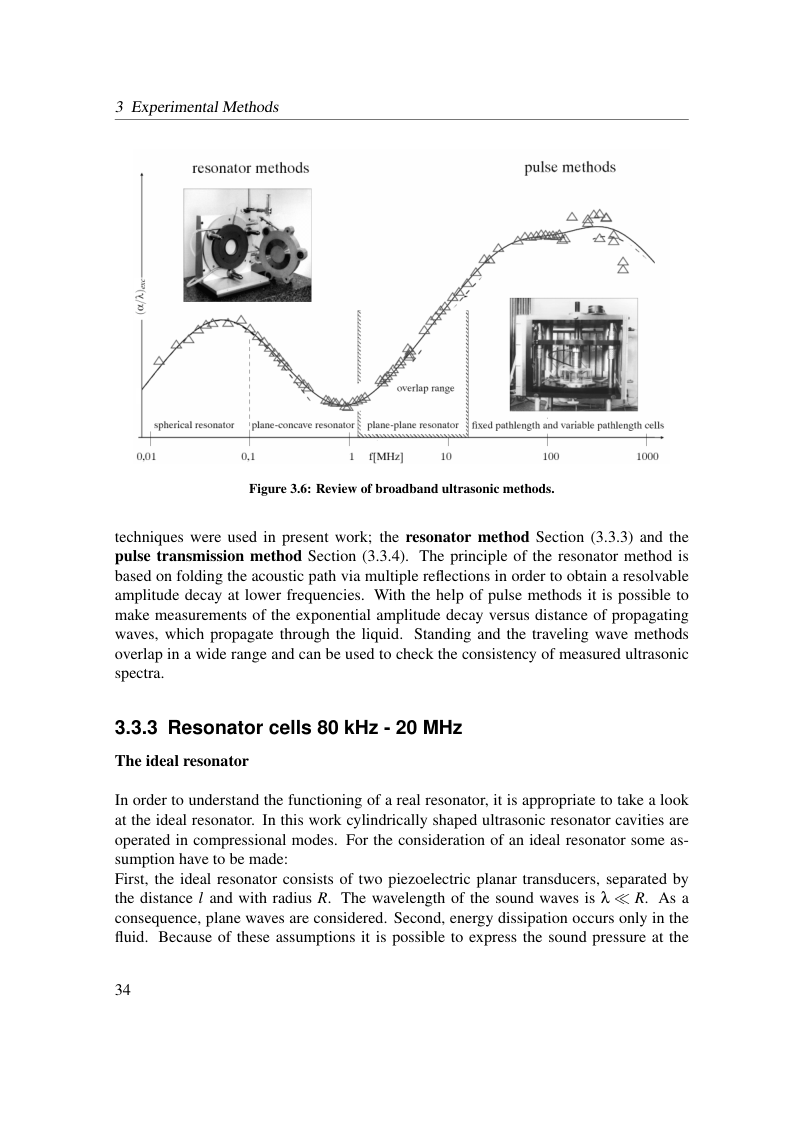
Figure 3.6: Review of broadband ultrasonic methods.
techniques were used in present work; the resonator method Section (3.3.3) and the pulse transmission method Section (3.3.4). The principle of the resonator method is based on folding the acoustic path via multiple reflections in order to obtain a resolvable amplitude decay at lower frequencies. With the help of pulse methods it is possible to make measurements of the exponential amplitude decay versus distance of propagating waves, which propagate through the liquid. Standing and the traveling wave methods overlap in a wide range and can be used to check the consistency of measured ultrasonic spectra.
3.3.3 Resonator cells 80 kHz - 20 MHz
The ideal resonator
In order to understand the functioning of a real resonator, it is appropriate to take a look at the ideal resonator. In this work cylindrically shaped ultrasonic resonator cavities are operated in compressional modes. For the consideration of an ideal resonator some as- sumption have to be made: First, the ideal resonator consists of two piezoelectric planar transducers, separated by the distance l and with radius R. The wavelength of the sound waves is λ ≪R. As a consequence, plane waves are considered. Second, energy dissipation occurs only in the fluid. Because of these assumptions it is possible to express the sound pressure at the
View original page 40 (authoritative equations, figures and layout)
Original dissertation · PDF page 40 · reader page 32 of 132