Original English dissertation · scientific equations reproduced directly from the source PDF.
3 Experimental Methods
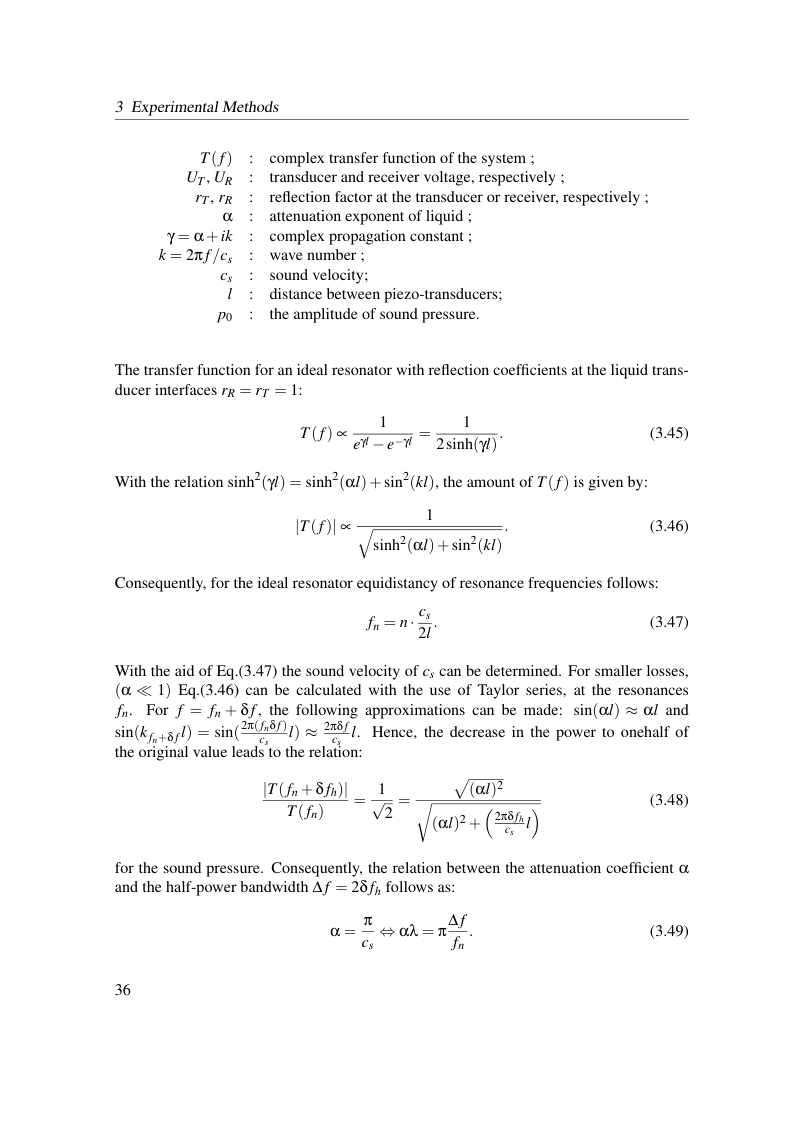
T(f) : complex transfer function of the system ; UT, UR : transducer and receiver voltage, respectively ; rT, rR : reflection factor at the transducer or receiver, respectively ; α : attenuation exponent of liquid ; γ = α+ik : complex propagation constant ; k = 2πf/cs : wave number ; cs : sound velocity; l : distance between piezo-transducers; p0 : the amplitude of sound pressure.
The transfer function for an ideal resonator with reflection coefficients at the liquid trans- ducer interfaces rR = rT = 1:

With the relation sinh2(γl) = sinh2(αl)+sin2(kl), the amount of T(f) is given by:

Consequently, for the ideal resonator equidistancy of resonance frequencies follows:

With the aid of Eq.(3.47) the sound velocity of cs can be determined. For smaller losses, (α ≪1) Eq.(3.46) can be calculated with the use of Taylor series, at the resonances fn. For f = fn + δf, the following approximations can be made: sin(αl) ≈αl and sin(k fn+δf l) = sin(2π(fnδf)
cs l) ≈2πδ f
cs l. Hence, the decrease in the power to onehalf of the original value leads to the relation:

for the sound pressure. Consequently, the relation between the attenuation coefficient α and the half-power bandwidth ∆f = 2δfh follows as:

View original page 42 (authoritative equations, figures and layout)
Original dissertation · PDF page 42 · reader page 34 of 132