Original English dissertation · scientific equations reproduced directly from the source PDF.
3 Experimental Methods
transducer cQ and its thickness d:

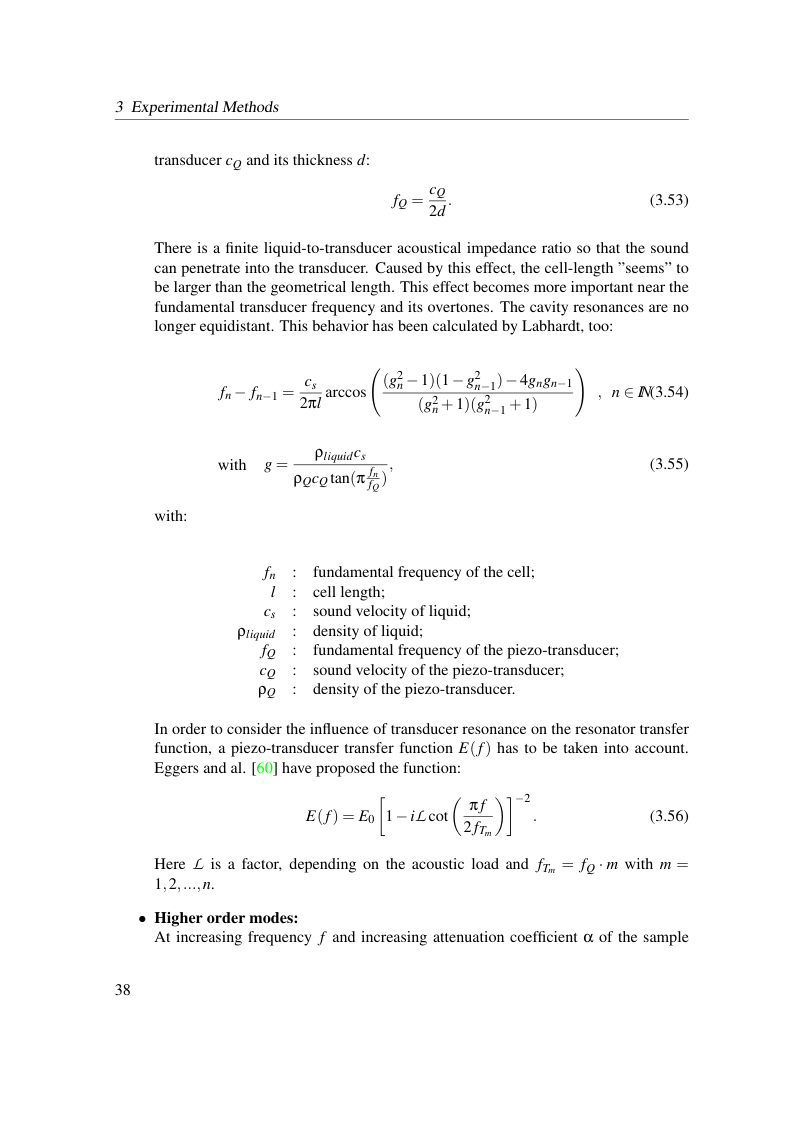
There is a finite liquid-to-transducer acoustical impedance ratio so that the sound can penetrate into the transducer. Caused by this effect, the cell-length ”seems” to be larger than the geometrical length. This effect becomes more important near the fundamental transducer frequency and its overtones. The cavity resonances are no longer equidistant. This behavior has been calculated by Labhardt, too:

with g = ρliquidcs ρQcQ tan(π fn

with:
fn : fundamental frequency of the cell; l : cell length; cs : sound velocity of liquid; ρliquid : density of liquid; fQ : fundamental frequency of the piezo-transducer; cQ : sound velocity of the piezo-transducer; ρQ : density of the piezo-transducer.
In order to consider the influence of transducer resonance on the resonator transfer function, a piezo-transducer transfer function E(f) has to be taken into account. Eggers and al. [60] have proposed the function:

2 fTm
Here L is a factor, depending on the acoustic load and fTm = fQ · m with m = 1,2,...,n.
• Higher order modes: At increasing frequency f and increasing attenuation coefficient α of the sample
View original page 44 (authoritative equations, figures and layout)
Original dissertation · PDF page 44 · reader page 36 of 132