Original English dissertation · scientific equations reproduced directly from the source PDF.
5 Experimental Verification of Dynamic Scaling Theories and Discussions
In the following chapter, the results of measurements of dynamic light scattering, shear viscosity and ultrasonic spectroscopy as well as the data evaluation procedures are pre- sented. The first Section describes the strategy in the fitting procedure of the scaling function within the framework of crossover theories as well as the Bhattacharjee-Ferrell theory. The second section lists the investigated substances and critical systems as well as their preparation. The third, fourth and fifth sections present the final results of the studies, classified by the complexity of the ultrasonic attenuation spectra: systems with- out or with one additional noncritical relaxation term, systems with complex background contributions, and ternary mixtures. The sixth section deals with correlations, e.g. with relations between quantities of different critical systems.
5.1 Strategies of verifying the scaling function
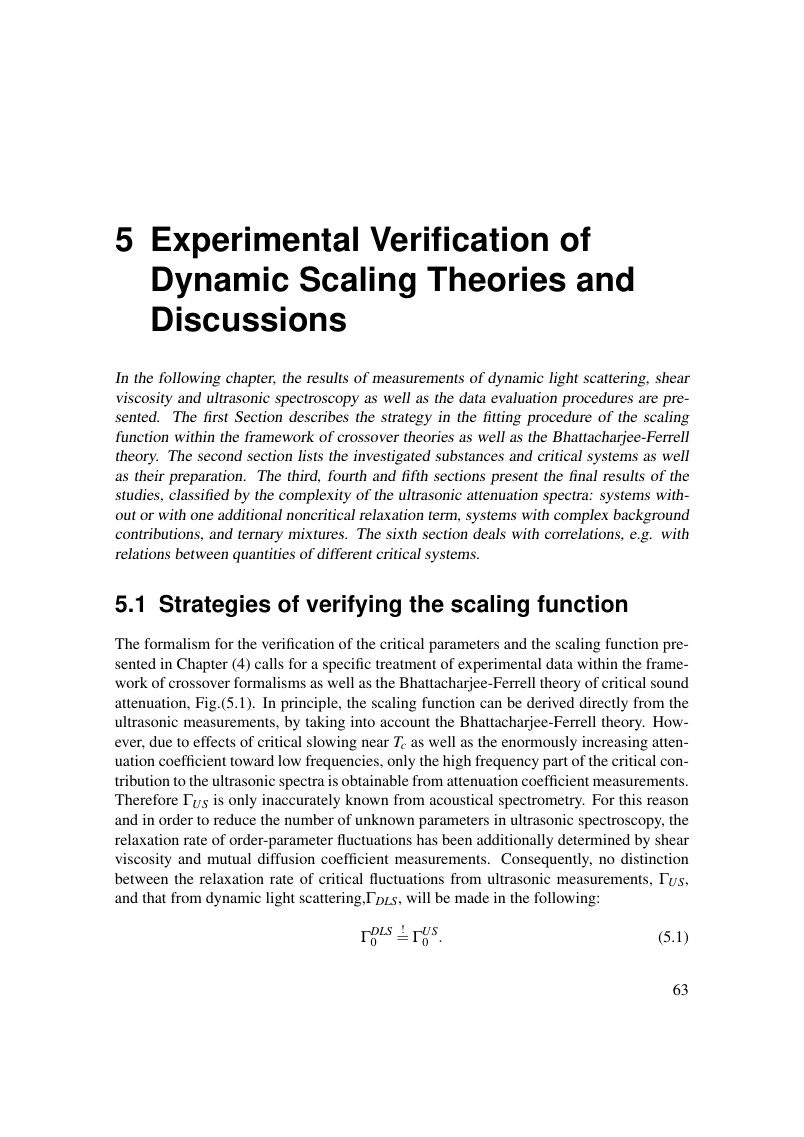
The formalism for the verification of the critical parameters and the scaling function pre- sented in Chapter (4) calls for a specific treatment of experimental data within the frame- work of crossover formalisms as well as the Bhattacharjee-Ferrell theory of critical sound attenuation, Fig.(5.1). In principle, the scaling function can be derived directly from the ultrasonic measurements, by taking into account the Bhattacharjee-Ferrell theory. How- ever, due to effects of critical slowing near Tc as well as the enormously increasing atten- uation coefficient toward low frequencies, only the high frequency part of the critical con- tribution to the ultrasonic spectra is obtainable from attenuation coefficient measurements. Therefore ΓUS is only inaccurately known from acoustical spectrometry. For this reason and in order to reduce the number of unknown parameters in ultrasonic spectroscopy, the relaxation rate of order-parameter fluctuations has been additionally determined by shear viscosity and mutual diffusion coefficient measurements. Consequently, no distinction between the relaxation rate of critical fluctuations from ultrasonic measurements, ΓUS, and that from dynamic light scattering,ΓDLS, will be made in the following:

View original page 69 (authoritative equations, figures and layout)
Original dissertation · PDF page 69 · reader page 60 of 132