Original English dissertation · scientific equations reproduced directly from the source PDF.
5 Experimental Verification of Dynamic Scaling Theories and Discussions
in Fig.(5.32) do not exactly confirmed this hypothesis. The shear viscosity data increase close to the consolute point in the range of absolute temperature T −Tc = 0.5 K, but the relaxation time data of the low-frequency term in the range of 7 K. Furthermore, the vis- cosity of the (TEA-H2O) mixture of critical composition varies near Tc as ηs = η0ε−0.04
only. Hence, the power law behavior in the relaxation time of the R+ D2(f) process cannot be solely due to effects of viscosity. There must exist an intrinsic mechanism that slows down near the critical demixing point. On the contrary, due to the exponent ν∗= 0.664 in the power law behavior of the mutual diffusion coefficient, it appears to be likely that the rotational isomerization is largely governed by the critical slowing of the mutual dif- fusion, D(ε) →0.
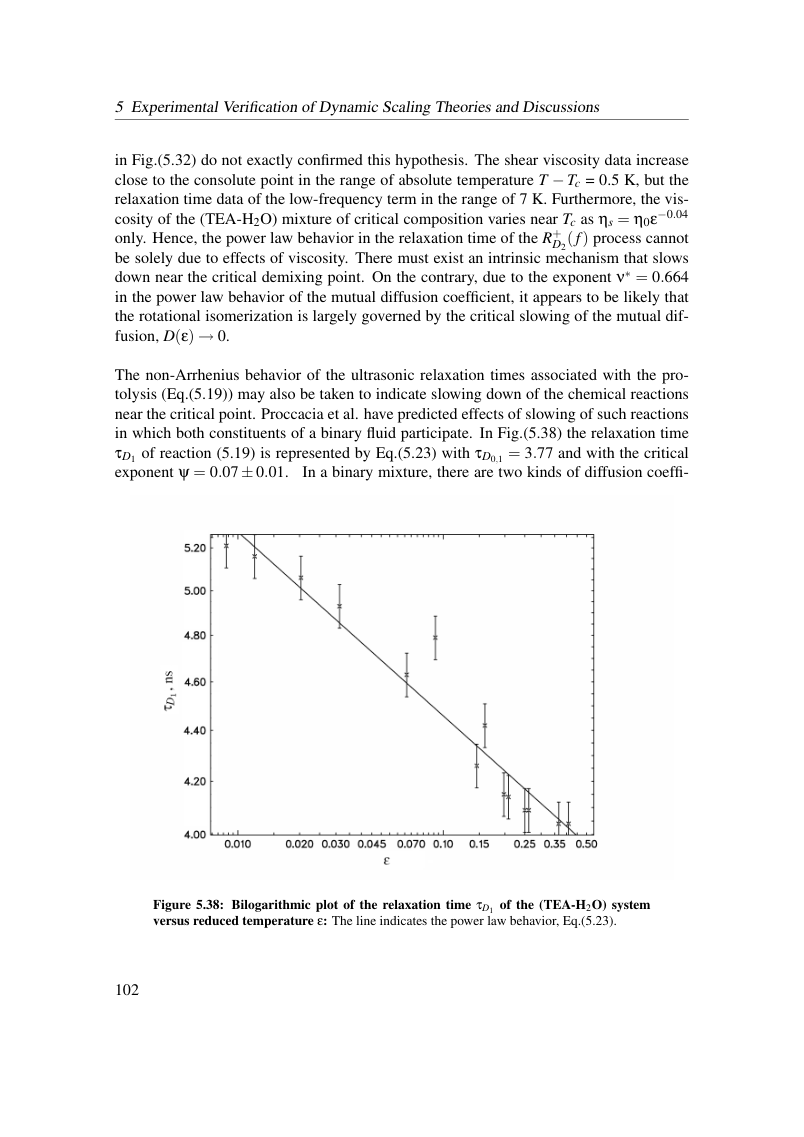
The non-Arrhenius behavior of the ultrasonic relaxation times associated with the pro- tolysis (Eq.(5.19)) may also be taken to indicate slowing down of the chemical reactions near the critical point. Proccacia et al. have predicted effects of slowing of such reactions in which both constituents of a binary fluid participate. In Fig.(5.38) the relaxation time τD1 of reaction (5.19) is represented by Eq.(5.23) with τD0,1 = 3.77 and with the critical exponent ψ = 0.07 ± 0.01. In a binary mixture, there are two kinds of diffusion coeffi-
Figure 5.38: Bilogarithmic plot of the relaxation time τD1 of the (TEA-H2O) system versus reduced temperature ε: The line indicates the power law behavior, Eq.(5.23).
View original page 108 (authoritative equations, figures and layout)
Original dissertation · PDF page 108 · reader page 99 of 132