Original English dissertation · scientific equations reproduced directly from the source PDF.
5.6 Systems with complex background contributions
asymptotic high frequency background parameter B ′ as well as the relaxation rate Γ and the critical amplitude SBF have been fixed at values obtained by inter-and extrapolation of data from the broadband spectra and from light scattering measurements [97], respec- tively. Hence only τD2 and AD2 were adjusted to reach optimum agreement of scaling function data with the analytical form Eq.(4.26). Three runs and previous data were in- vestigated [97]. The result of the regression analysis is shown by Fig.(5.37). Since the critical contribution resulted from subtraction of the noncritical parts from the total attenu- ation, the scatter in the F(Ω) data is rather large. Within the limits of this scatter, however, the data from different runs and different temperatures of measurement fall on one curve and agree with the empirical scaling function according to Bhattacharjee-Ferrell formal- ism, with Ω1/2 = 2.1. The finding of a longer relaxation time (14 ns ≤τD2 ≤26 ns) for aqueous solutions in [97] than pure non-associating TEA may reflect the collective redis- tribution of solvent molecules associated with the structural isomerization of the solute. This effect has been also reported in [129] mixtures water-alcohol. However, from the
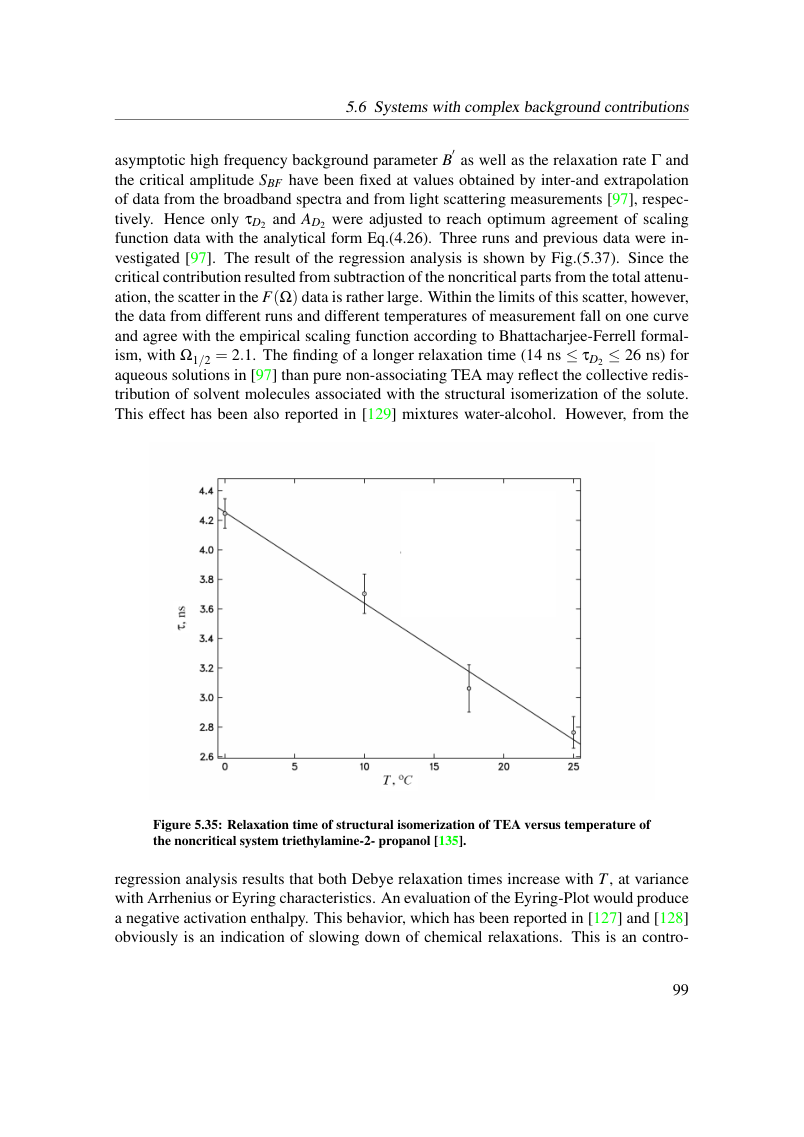
Figure 5.35: Relaxation time of structural isomerization of TEA versus temperature of the noncritical system triethylamine-2- propanol [135].
regression analysis results that both Debye relaxation times increase with T, at variance with Arrhenius or Eyring characteristics. An evaluation of the Eyring-Plot would produce a negative activation enthalpy. This behavior, which has been reported in [127] and [128] obviously is an indication of slowing down of chemical relaxations. This is an contro-
View original page 105 (authoritative equations, figures and layout)
Original dissertation · PDF page 105 · reader page 96 of 132