Original English dissertation · scientific equations reproduced directly from the source PDF.
5 Experimental Verification of Dynamic Scaling Theories and Discussions
versially discussed effect, which has been questioned by Milner and Martin [130] on the one side and confirmed by Procaccia [127], [27], Gitterman [132] as well as Krichevskii [134] and Wheeler [133] on the other side. Especially the low-frequency Debye term in frequency range of critical fluctuation contributions, assumed to be due to a uni-molecular reaction has to be considered with more details. According to the predictions by Proccacia et al. such uni-molecular reactions should be unaffected by the critical fluctuations. An example taken from literature [135] of a correct Arrhenius behavior of the non-aqueous and noncritical system triethylamine-2-propanol is presented in Fig.(5.35). Investigations
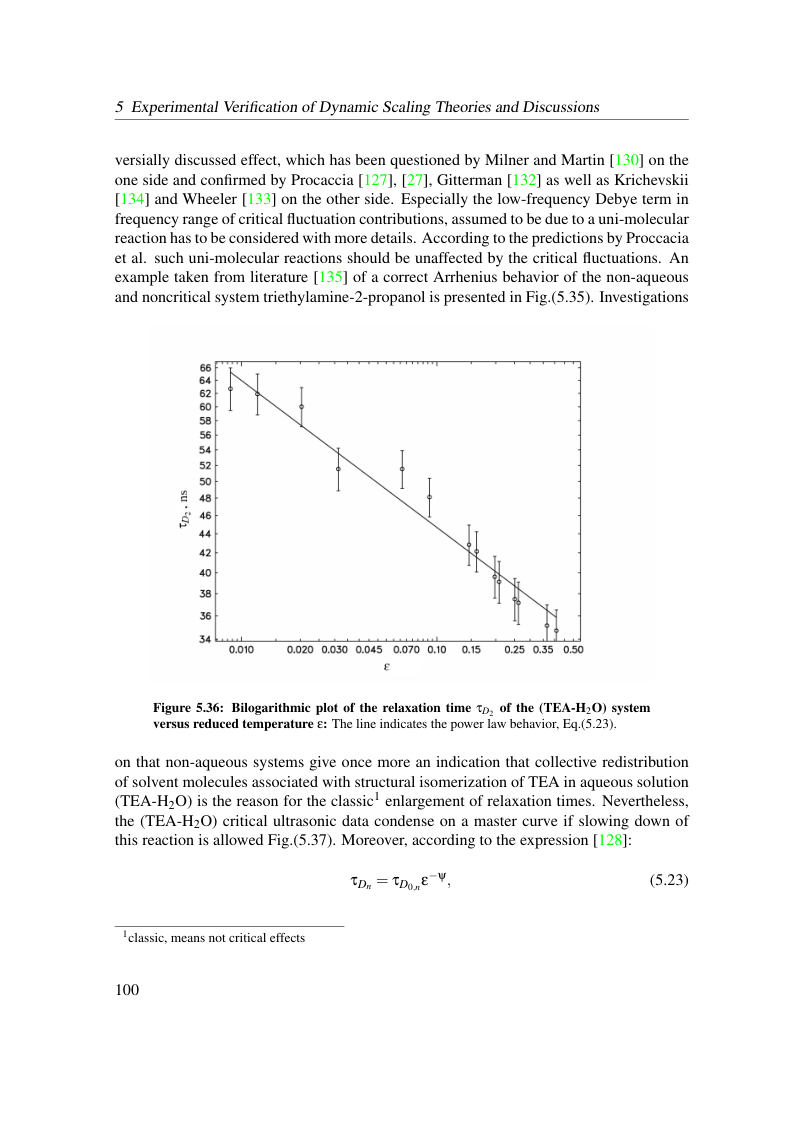
Figure 5.36: Bilogarithmic plot of the relaxation time τD2 of the (TEA-H2O) system versus reduced temperature ε: The line indicates the power law behavior, Eq.(5.23).
on that non-aqueous systems give once more an indication that collective redistribution of solvent molecules associated with structural isomerization of TEA in aqueous solution (TEA-H2O) is the reason for the classic1 enlargement of relaxation times. Nevertheless, the (TEA-H2O) critical ultrasonic data condense on a master curve if slowing down of this reaction is allowed Fig.(5.37). Moreover, according to the expression [128]:

1classic, means not critical effects
View original page 106 (authoritative equations, figures and layout)
Original dissertation · PDF page 106 · reader page 97 of 132