Original English dissertation · scientific equations reproduced directly from the source PDF.
3 Experimental Methods
3.2 Dynamic light scattering
In the last decades, light scattering techniques have been used with increasing effort for investigations of the physical properties of pure fluids and multicomponent fluids. The dynamic light scattering is a very powerful technique to determine the size of particles or to study critical fluctuations in multi-component fluids. According to the semi-classical theory, when light interacts with matter, the electric field of the light induces an oscillating electronic polarization in the molecules or atoms. With the aid of electromagnetic theory, statistical mechanics and hydrodynamics it is possible to gain information about the struc- tural and dynamic properties of a sample. In the present work the interest is focused on the critical fluctuations.
3.2.1 Electromagnetic scattering theory
In the following, the underlying theory of dynamic light scattering on fluids is briefly summarized. For a more detailed description the reader is referred to specialized litera- ture [46], [47], [48].
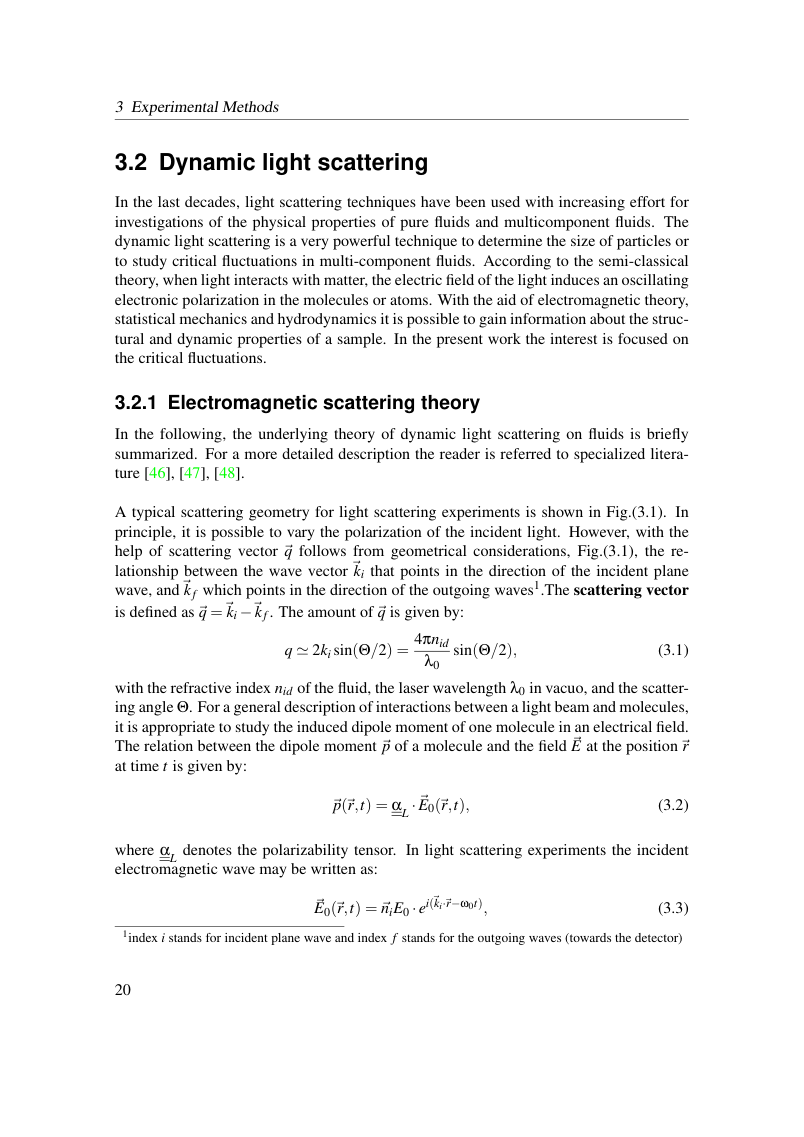
A typical scattering geometry for light scattering experiments is shown in Fig.(3.1). In principle, it is possible to vary the polarization of the incident light. However, with the help of scattering vector ⃗q follows from geometrical considerations, Fig.(3.1), the re- lationship between the wave vector ⃗ki that points in the direction of the incident plane wave, and⃗k f which points in the direction of the outgoing waves1.The scattering vector is defined as⃗q =⃗ki −⃗k f . The amount of⃗q is given by:

with the refractive index nid of the fluid, the laser wavelength λ0 in vacuo, and the scatter- ing angle Θ. For a general description of interactions between a light beam and molecules, it is appropriate to study the induced dipole moment of one molecule in an electrical field. The relation between the dipole moment ⃗p of a molecule and the field ⃗E at the position⃗r at time t is given by:

where αL denotes the polarizability tensor. In light scattering experiments the incident electromagnetic wave may be written as:

1index i stands for incident plane wave and index f stands for the outgoing waves (towards the detector)
View original page 26 (authoritative equations, figures and layout)
Original dissertation · PDF page 26 · reader page 18 of 132