Original English dissertation · scientific equations reproduced directly from the source PDF.
3.2 Dynamic light scattering
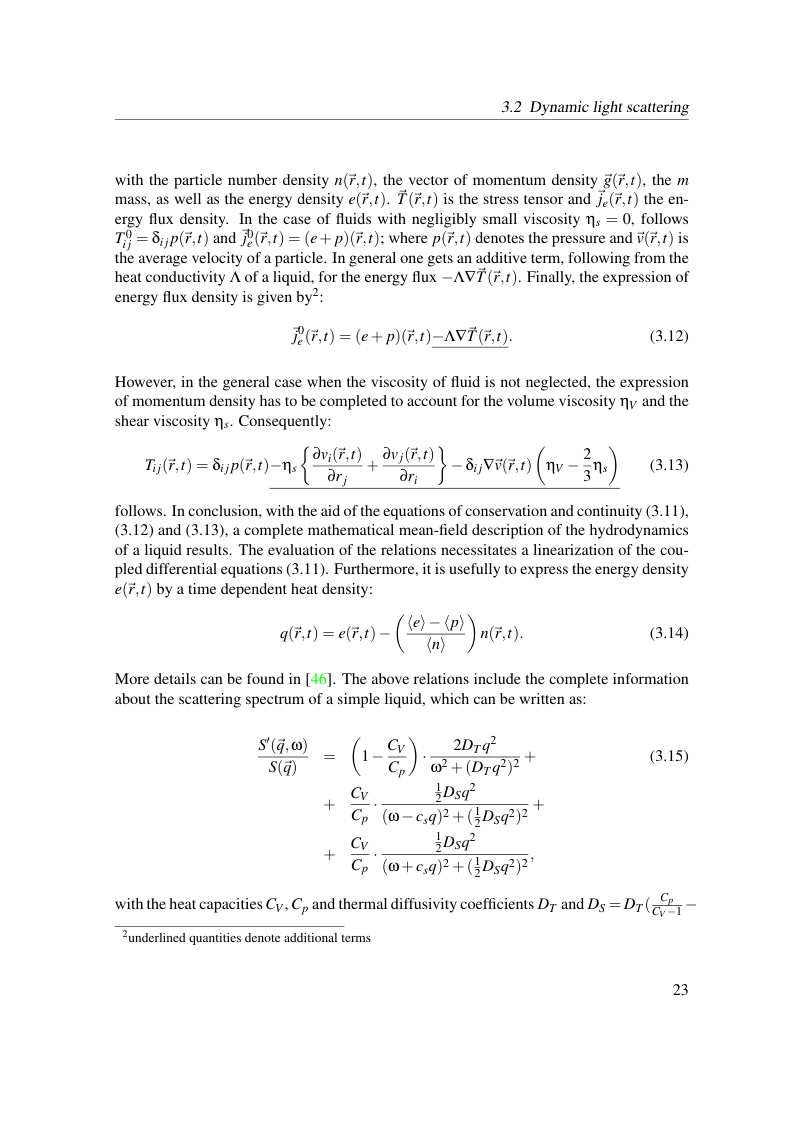
with the particle number density n(⃗r,t), the vector of momentum density ⃗g(⃗r,t), the m mass, as well as the energy density e(⃗r,t). ⃗T(⃗r,t) is the stress tensor and ⃗je(⃗r,t) the en- ergy flux density. In the case of fluids with negligibly small viscosity ηs = 0, follows T 0 i j = δi jp(⃗r,t) and ⃗j0 e(⃗r,t) = (e+ p)(⃗r,t); where p(⃗r,t) denotes the pressure and⃗v(⃗r,t) is the average velocity of a particle. In general one gets an additive term, following from the heat conductivity Λ of a liquid, for the energy flux −Λ∇⃗T(⃗r,t). Finally, the expression of energy flux density is given by2:

However, in the general case when the viscosity of fluid is not neglected, the expression of momentum density has to be completed to account for the volume viscosity ηV and the shear viscosity ηs. Consequently:

follows. In conclusion, with the aid of the equations of conservation and continuity (3.11), (3.12) and (3.13), a complete mathematical mean-field description of the hydrodynamics of a liquid results. The evaluation of the relations necessitates a linearization of the cou- pled differential equations (3.11). Furthermore, it is usefully to express the energy density e(⃗r,t) by a time dependent heat density:

More details can be found in [46]. The above relations include the complete information about the scattering spectrum of a simple liquid, which can be written as:

with the heat capacitiesCV, Cp and thermal diffusivity coefficients DT and DS = DT( Cp
CV −1 −
2underlined quantities denote additional terms
View original page 29 (authoritative equations, figures and layout)
Original dissertation · PDF page 29 · reader page 21 of 132