Original English dissertation · scientific equations reproduced directly from the source PDF.
3 Experimental Methods
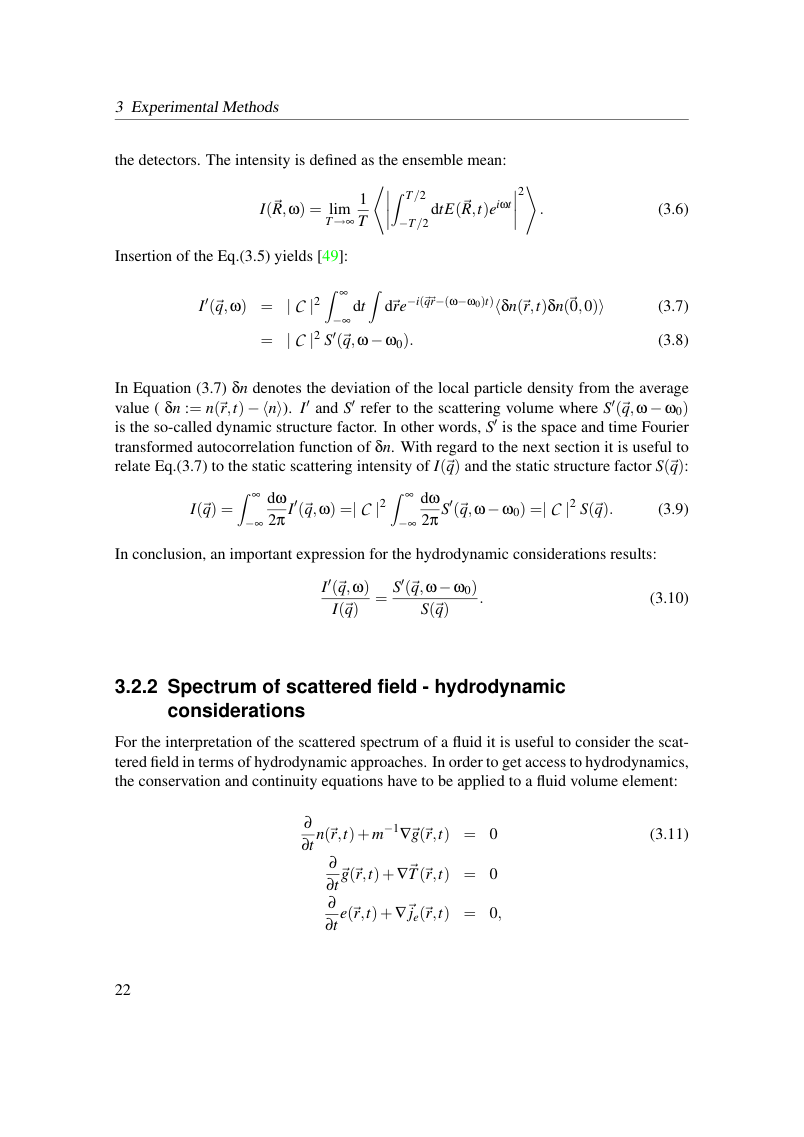
the detectors. The intensity is defined as the ensemble mean:

Insertion of the Eq.(3.5) yields [49]:


In Equation (3.7) δn denotes the deviation of the local particle density from the average value ( δn := n(⃗r,t) −⟨n⟩). I′ and S′ refer to the scattering volume where S′(⃗q,ω −ω0) is the so-called dynamic structure factor. In other words, S′ is the space and time Fourier transformed autocorrelation function of δn. With regard to the next section it is useful to relate Eq.(3.7) to the static scattering intensity of I(⃗q) and the static structure factor S(⃗q):

In conclusion, an important expression for the hydrodynamic considerations results:

3.2.2 Spectrum of scattered field - hydrodynamic considerations
For the interpretation of the scattered spectrum of a fluid it is useful to consider the scat- tered field in terms of hydrodynamic approaches. In order to get access to hydrodynamics, the conservation and continuity equations have to be applied to a fluid volume element:

View original page 28 (authoritative equations, figures and layout)
Original dissertation · PDF page 28 · reader page 20 of 132