Original English dissertation · scientific equations reproduced directly from the source PDF.
3.2 Dynamic light scattering

with the correlation length ξ. More detailed descriptions of the mutual diffusion coeffi- cient and its corrections within the scope of dynamic scaling and crossover theory will be presented in Chapter (4).
3.2.3 Data evaluation of dynamic light scattering
The central quantity of the evaluation of correlation spectroscopy is the decay time also named the correlation-time τc. Unfortunately, it is not possible to detect this frequency with classical optical methods. As a consequence, it is substantial to use optical mixing techniques, like homogenous mixing, heterogenous mixing (homodyne and heterodyne techniques) and the self-beating method. The last one, has been used in present thesis and will be described below.
3.2.4 Self-beating spectroscopy
The principle of self-beating spectroscopy is based on mixing of scattered light with the original light on analyzing the resulting signal with low-frequency intermediate signal. This is realized in three steps.
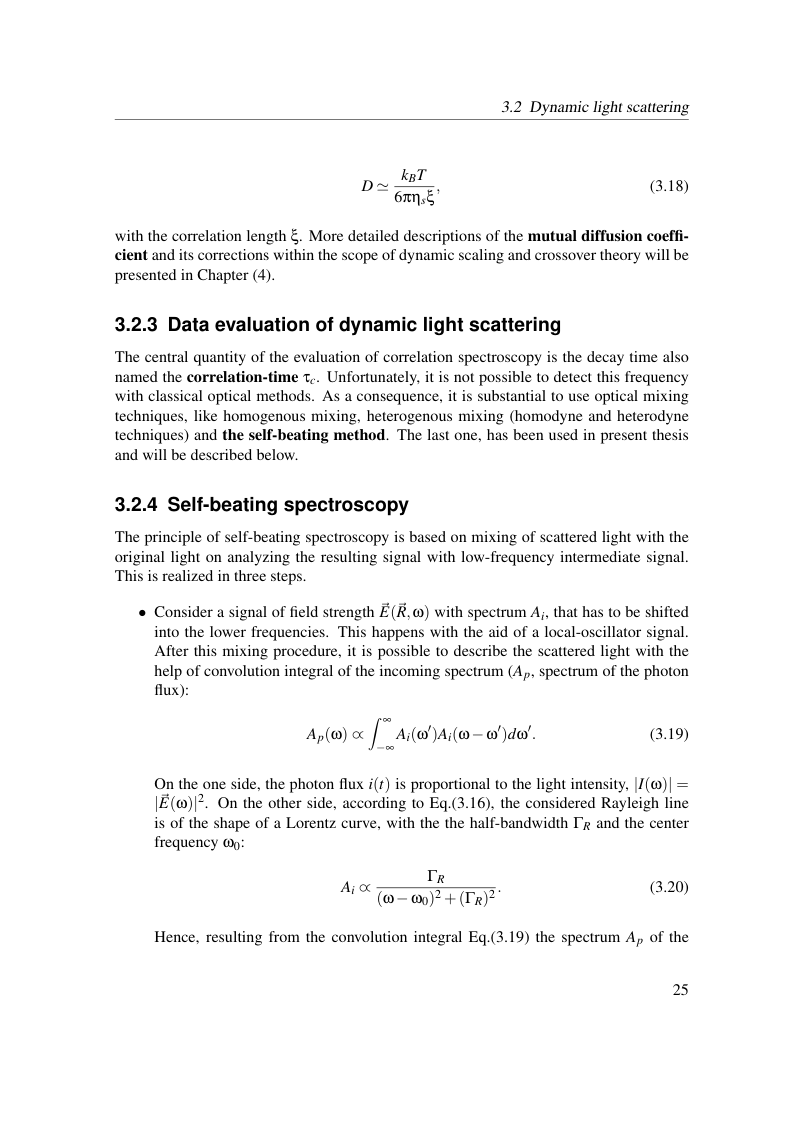
• Consider a signal of field strength ⃗E(⃗R,ω) with spectrum Ai, that has to be shifted into the lower frequencies. This happens with the aid of a local-oscillator signal. After this mixing procedure, it is possible to describe the scattered light with the help of convolution integral of the incoming spectrum (Ap, spectrum of the photon flux):

On the one side, the photon flux i(t) is proportional to the light intensity, |I(ω)| = |⃗E(ω)|2. On the other side, according to Eq.(3.16), the considered Rayleigh line is of the shape of a Lorentz curve, with the the half-bandwidth ΓR and the center frequency ω0:

Hence, resulting from the convolution integral Eq.(3.19) the spectrum Ap of the
View original page 31 (authoritative equations, figures and layout)
Original dissertation · PDF page 31 · reader page 23 of 132