Original English dissertation · scientific equations reproduced directly from the source PDF.
3.4 Complementary measurement techniques
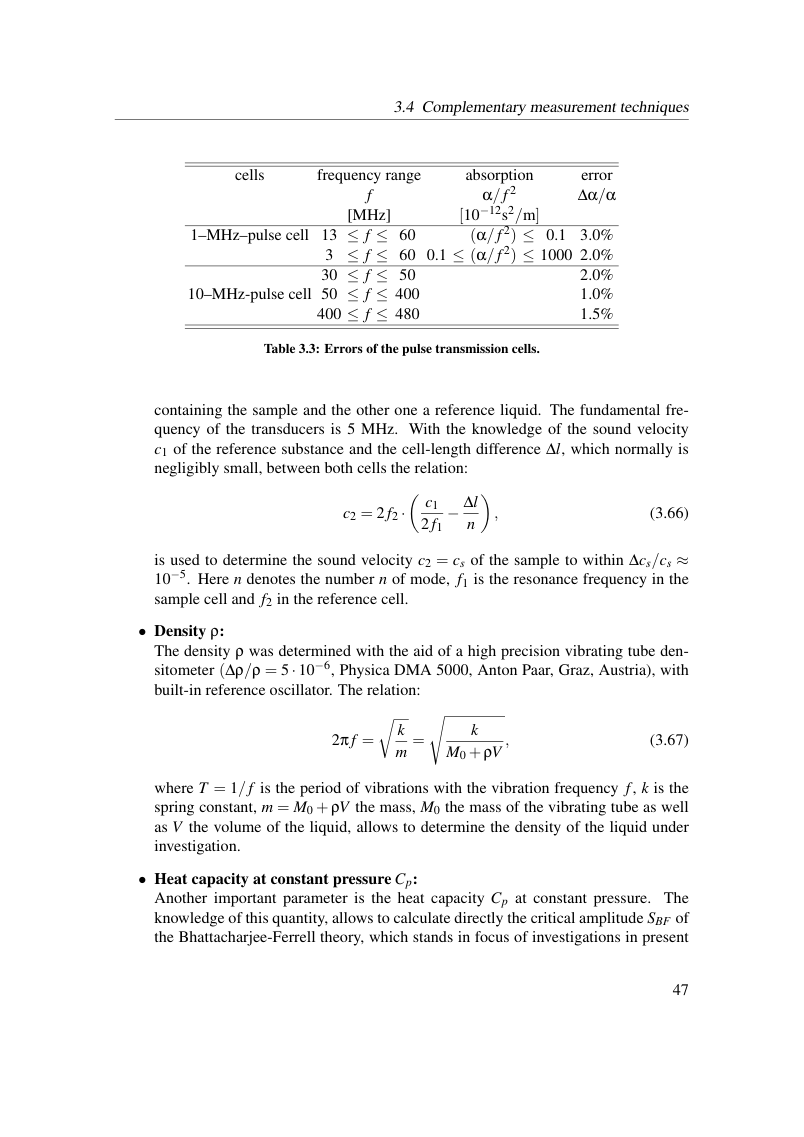
cells frequency range absorption error f α/ f 2 ∆α/α [MHz] [10−12s2/m] 1–MHz–pulse cell 13 ≤f ≤60 (α/ f 2) ≤0.1 3.0% 3 ≤f ≤60 0.1 ≤(α/ f 2) ≤1000 2.0% 30 ≤f ≤50 2.0% 10–MHz-pulse cell 50 ≤f ≤400 1.0% 400 ≤f ≤480 1.5%
Table 3.3: Errors of the pulse transmission cells.
containing the sample and the other one a reference liquid. The fundamental fre- quency of the transducers is 5 MHz. With the knowledge of the sound velocity c1 of the reference substance and the cell-length difference ∆l, which normally is negligibly small, between both cells the relation:

is used to determine the sound velocity c2 = cs of the sample to within ∆cs/cs ≈ 10−5. Here n denotes the number n of mode, f1 is the resonance frequency in the sample cell and f2 in the reference cell.
• Density ρ: The density ρ was determined with the aid of a high precision vibrating tube den- sitometer (∆ρ/ρ = 5 ·10−6, Physica DMA 5000, Anton Paar, Graz, Austria), with built-in reference oscillator. The relation:

where T = 1/ f is the period of vibrations with the vibration frequency f, k is the spring constant, m = M0 +ρV the mass, M0 the mass of the vibrating tube as well as V the volume of the liquid, allows to determine the density of the liquid under investigation.
• Heat capacity at constant pressure Cp: Another important parameter is the heat capacity Cp at constant pressure. The knowledge of this quantity, allows to calculate directly the critical amplitude SBF of the Bhattacharjee-Ferrell theory, which stands in focus of investigations in present
View original page 53 (authoritative equations, figures and layout)
Original dissertation · PDF page 53 · reader page 45 of 132