Original English dissertation · scientific equations reproduced directly from the source PDF.
5 Experimental Verification of Dynamic Scaling Theories and Discussions
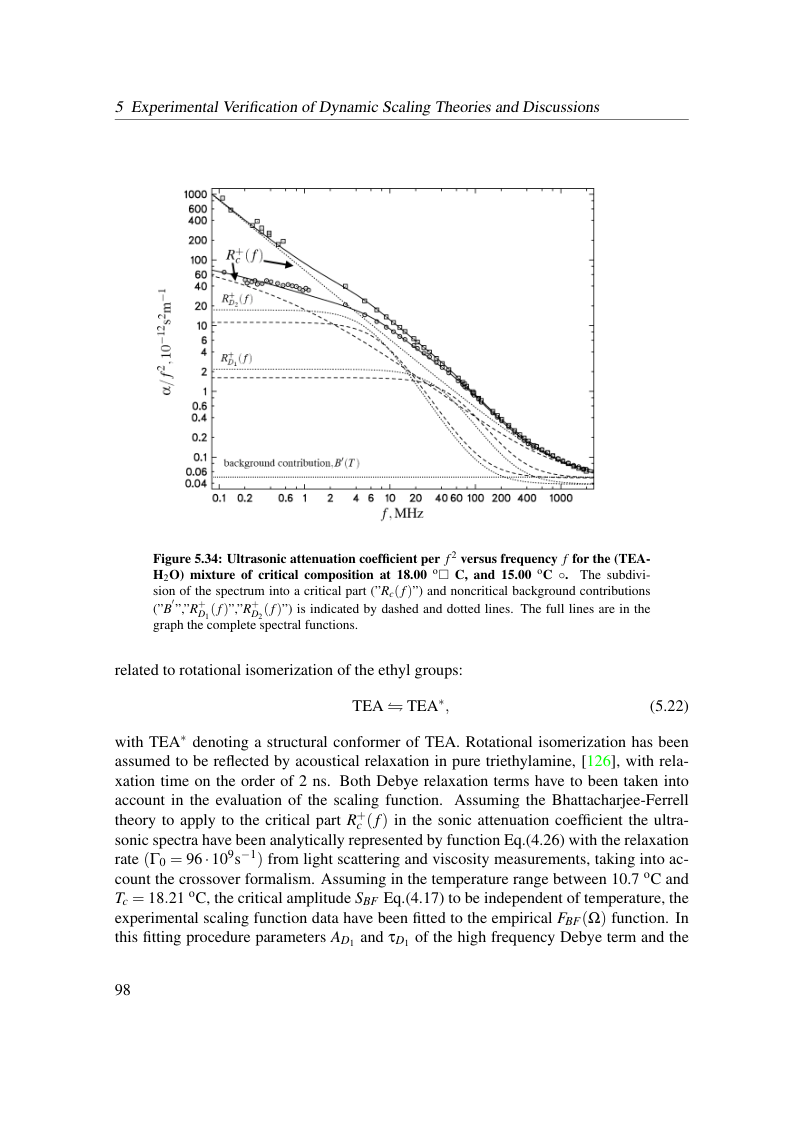
Figure 5.34: Ultrasonic attenuation coefficient per f 2 versus frequency f for the (TEA- H2O) mixture of critical composition at 18.00 o□C, and 15.00 oC ◦. The subdivi- sion of the spectrum into a critical part (”Rc(f)”) and noncritical background contributions (”B ′”,”R+ D1(f)”,”R+ D2(f)”) is indicated by dashed and dotted lines. The full lines are in the graph the complete spectral functions.
related to rotational isomerization of the ethyl groups:

with TEA∗denoting a structural conformer of TEA. Rotational isomerization has been assumed to be reflected by acoustical relaxation in pure triethylamine, [126], with rela- xation time on the order of 2 ns. Both Debye relaxation terms have to been taken into account in the evaluation of the scaling function. Assuming the Bhattacharjee-Ferrell theory to apply to the critical part R+ c (f) in the sonic attenuation coefficient the ultra- sonic spectra have been analytically represented by function Eq.(4.26) with the relaxation rate (Γ0 = 96·109s−1) from light scattering and viscosity measurements, taking into ac- count the crossover formalism. Assuming in the temperature range between 10.7 oC and Tc = 18.21 oC, the critical amplitude SBF Eq.(4.17) to be independent of temperature, the experimental scaling function data have been fitted to the empirical FBF(Ω) function. In this fitting procedure parameters AD1 and τD1 of the high frequency Debye term and the
View original page 104 (authoritative equations, figures and layout)
Original dissertation · PDF page 104 · reader page 95 of 132