Original English dissertation · scientific equations reproduced directly from the source PDF.
3 Experimental Methods
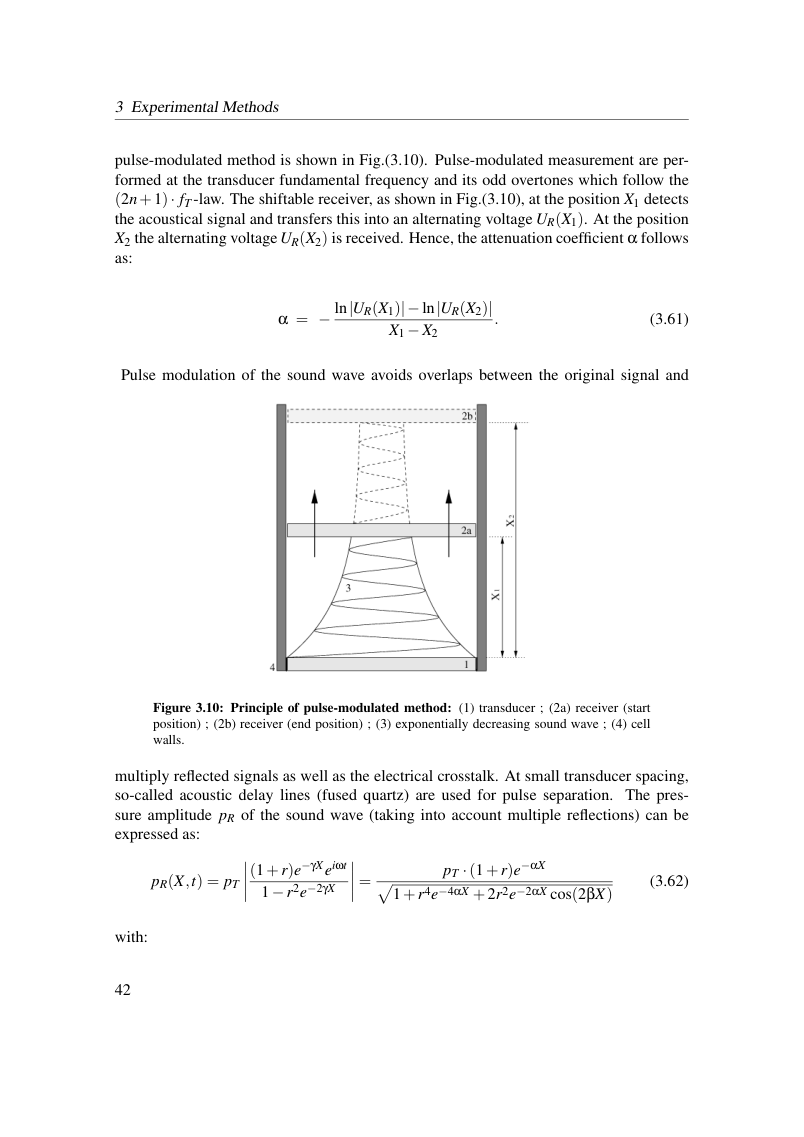
pulse-modulated method is shown in Fig.(3.10). Pulse-modulated measurement are per- formed at the transducer fundamental frequency and its odd overtones which follow the (2n+1)· fT-law. The shiftable receiver, as shown in Fig.(3.10), at the position X1 detects the acoustical signal and transfers this into an alternating voltage UR(X1). At the position X2 the alternating voltage UR(X2) is received. Hence, the attenuation coefficient α follows as:

Pulse modulation of the sound wave avoids overlaps between the original signal and
Figure 3.10: Principle of pulse-modulated method: (1) transducer ; (2a) receiver (start position) ; (2b) receiver (end position) ; (3) exponentially decreasing sound wave ; (4) cell walls.
multiply reflected signals as well as the electrical crosstalk. At small transducer spacing, so-called acoustic delay lines (fused quartz) are used for pulse separation. The pres- sure amplitude pR of the sound wave (taking into account multiple reflections) can be expressed as:

with:
View original page 48 (authoritative equations, figures and layout)
Original dissertation · PDF page 48 · reader page 40 of 132